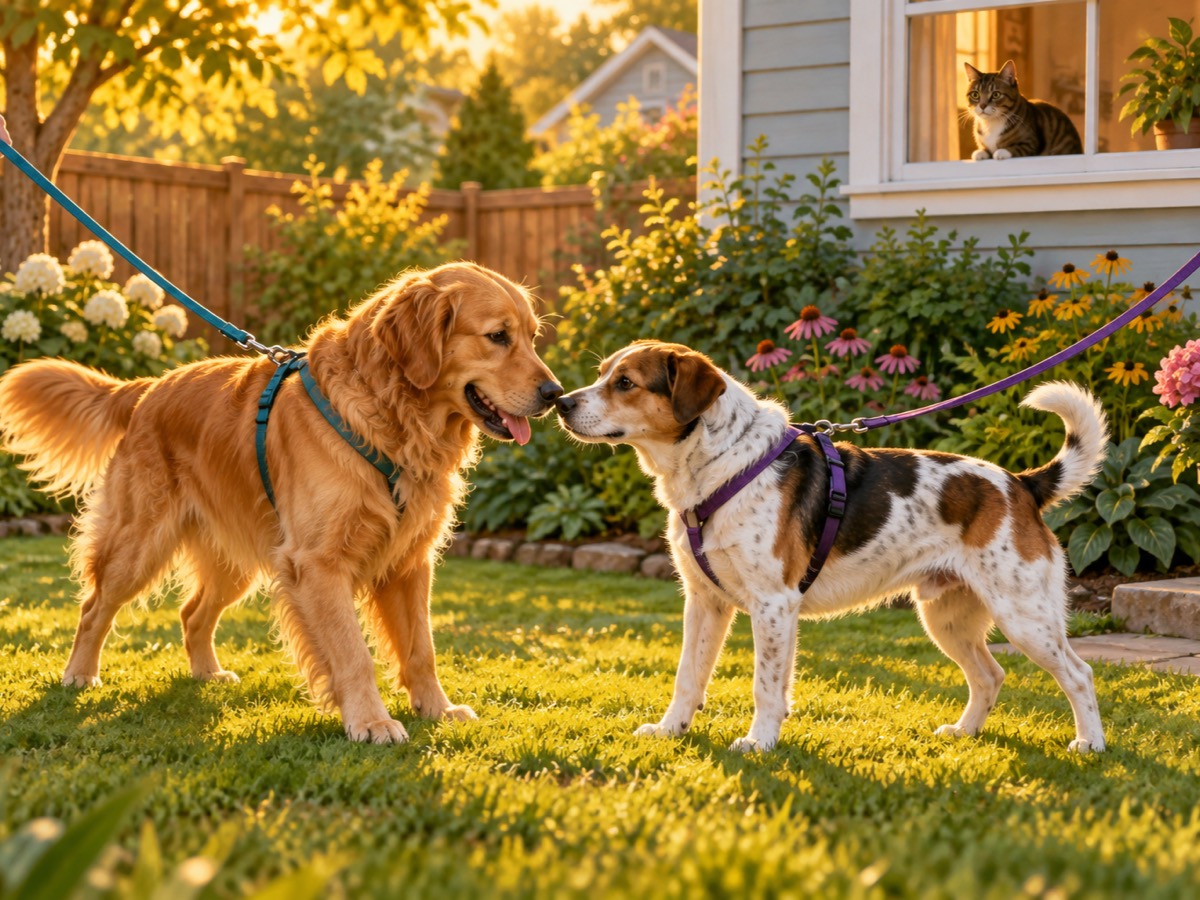
Your dog is talking to you all day long. Not with barks, those are actually a small part of canine communication, but with ears, eyes, tail, mouth, and the way they hold their weight. Dogs read each other this way fluently. Most of us humans, though, catch only the loudest signals and miss the quiet ones that come first. Learning this language is one of the most practical skills a dog owner can build: it helps you comfort a nervous dog before fear escalates, step in before a tense moment at the dog park becomes a scuffle, and understand what your own dog genuinely enjoys.
The Tail: More Complicated Than “Wagging Means Happy”
The single biggest myth in dog body language is that a wagging tail means a friendly dog. What a wag actually tells you is that the dog is emotionally aroused, and arousal can be joyful, frustrated, or agitated. To read it accurately, look at speed and position together. A loose, sweeping wag at mid-height, often with the whole rear end wiggling, usually signals a relaxed, happy dog. The full-circle “helicopter” wag is about as unambiguous as dog joy gets. But a tail held high and stiff, twitching in short fast strokes, belongs to a dog on high alert, and that situation deserves caution, not an outstretched hand.
Tail height matters as much as movement. A tail carried low or tucked tight between the rear legs signals fear or appeasement. A tail raised well above the back broadcasts confidence or arousal. Keep breed in mind, too: a Greyhound’s neutral tail hangs low, while a Pug’s curls high at rest, so learn what “normal” looks like for the individual dog in front of you.
Eyes and Ears: The Early Warning System
A comfortable dog has soft eyes, relaxed lids, sometimes an almost squinty look. A dog in trouble has hard eyes: fixed, intense, and cold. One signal every owner should know by name is “whale eye,” when a dog turns their head slightly away from something but keeps watching it, so the whites of the eyes show in a crescent. Whale eye is a reliable sign of stress or anxiety, and it often appears when a dog is being hugged, cornered, or hovered over near a bone or bowl. Behavior professionals treat it as an urgent request for space, and it can be one of the last warnings before a frightened dog feels forced to escalate.
A hard, direct stare aimed at a person or another dog is a threat signal; deliberately looking away is the opposite, a de-escalation move. Ears tell a parallel story. Forward-pricked ears show interest or arousal; ears pinned flat against the skull show fear. Floppy-eared breeds are subtler, but you can still watch the base of the ear for the same forward or backward movement.
Mouth Signals: Yawns, Licks, and What Teeth Really Mean
Some of the most commonly missed stress signals happen around the mouth, and they’re easy to misread as something innocent. A dog who yawns repeatedly at the vet’s office isn’t sleepy, and a dog who flicks their tongue over their nose when a toddler leans in isn’t tasting the air. Quick, out-of-context lip licks and yawns are classic stress signals dogs use when uneasy. They’re fast and subtle, so you have to be watching for them, but once you start noticing, you’ll see them everywhere: during nail trims, hugs, and photo sessions.
Teeth need context. A snarl with a wrinkled muzzle, stiff body, and low growl is a clear warning to back off, and a dog who growls is doing you a favor by communicating before biting, so never punish a growl. But some dogs also offer a “submissive grin,” front teeth bared with squinty eyes, lowered posture, and a wiggly body, which is an appeasement gesture, not aggression. Panting when the dog isn’t hot or fresh from exercise can be another sign of stress, especially in tense settings like a clinic waiting room.
Posture: Reading the Whole Dog
Weight distribution is the big-picture signal. A frightened dog makes itself small: hunched body, lowered head, tail tucked, weight shifted back over the rear legs ready to retreat, sometimes cowering all the way to the ground. A dog shifting weight forward, with a tall, stiff stance, is projecting interest or a possible threat. Raised hackles, the strip of fur standing up along the back and shoulders, mean arousal but not necessarily aggression; dogs can raise hackles from excitement or surprise too, like goosebumps in humans.
Then there are the happy postures. The play bow, chest dropped to the ground, rear end in the air, is an invitation that essentially says everything after this is a game. A dog who rolls over to expose the belly may be asking for a rub if their body is loose and wiggly, but the same position with a stiff body, tucked tail, and averted eyes is appeasement, a dog asking for the interaction to stop. A raised front paw often signals uncertainty. As always, read the cluster of signals, never a single one in isolation.
Putting It Into Practice
The skill that ties all of this together is watching for change. A dog who was loose and wiggly a moment ago and is now still, closed-mouthed, and leaning away is telling you something shifted. Here’s how to make the language useful day to day:
- When you see stress signals, lip licking, yawning, whale eye, turning away, give your dog distance from whatever triggered them rather than pushing through
- Teach children to let dogs approach them, and to stop petting when a dog leans away, stiffens, or shows whale eye
- Watch play sessions for role reversals and frequent pauses, which signal healthy play, and interrupt calmly when one dog stiffens or stops taking breaks
- Never punish growling; instead, note what caused it and make that situation easier next time
- Film your dog in everyday situations and review the footage; subtle signals are far easier to catch on replay
Body language fluency pays off everywhere: it makes obedience training faster because you can see when your dog is engaged versus overwhelmed, it makes vet visits less stressful because you can advocate for a break before your dog panics, and it deepens trust, because your dog learns that their quiet signals work on you.
If your dog shows frequent stress signals in ordinary situations, or you’re seeing escalation like growling or snapping, don’t guess your way through it. A certified professional trainer or a veterinary behaviorist can build a plan tailored to your dog. For everyday life, though, the basics above cover most of what your dog has been trying to tell you all along. The conversation was always happening; now you’re part of it.