Walking gear looks like a minor decision until the first time your dog lunges at a squirrel and you feel exactly how much force is landing on their throat, or on your shoulder. What you clip on shapes how safe the walk is, how much control you have, and in some cases how your dog behaves on leash at all.
Here is a plain comparison of the main categories and how to fit each one so it works.
Collars: identification first, control second
Every dog needs a flat collar, but the most important job it does has nothing to do with walking. It carries your dog’s ID tags and rabies tag, which is what gets a lost dog home fast when nobody has a chip scanner handy. Keep one on your dog whenever they are not crated, regardless of what you walk them in.
Flat collars are fine as a leash attachment point for dogs who already walk politely. The problem appears the moment a dog pulls, because all of that force concentrates on a narrow band around the neck. Veterinarians routinely steer owners away from neck attachment for dogs with respiratory or spinal conditions, and for small breeds prone to tracheal collapse, such as Yorkshire Terriers, Chihuahuas, and Pomeranians, a harness is often treated as non-negotiable. The same goes for flat-faced breeds like Pugs and French Bulldogs, who are already working harder than average to breathe.
Martingale collars have a limited-slip design: they tighten slightly when the dog pulls, but a well-fitted one stops at a preset point and cannot close down like a choke chain. Their real value is escape prevention for dogs whose heads are narrower than their necks, which describes most sighthounds and plenty of nervous newly adopted dogs. Fit it so that at full tension you can still slide two fingers underneath, and take it off for unsupervised time, since the sliding loop can snag.
Head halters loop over the muzzle and steer the head, which gives a small person real leverage over a large strong dog. They can be useful, but they need patient conditioning first, they need a short leash, and a hard lunge on one can wrench the neck. Treat them as management alongside training, not a substitute for it.
The gear to skip
Choke chains, prong collars, and electronic or shock collars all work by causing discomfort or pain. The American Veterinary Society of Animal Behavior has issued a position statement on humane dog training recommending reward-based methods for all dog training, including the treatment of behavior problems, and stating that aversive methods should not be used. Its reasoning is straightforward: there is no evidence that aversive tools outperform reward-based methods, and they carry real risk of increasing fear, anxiety, and aggression.
The practical failure mode matters too. A dog who gets pinched every time another dog appears can learn that other dogs predict pain, which is the last association you want in a reactive dog. If pulling is the problem, a front-clip harness plus a few weeks of loose-leash work gets you further. Our guide to basic obedience skills every owner should teach covers the foundation.
Harnesses: where the leash clips changes everything
A harness spreads pressure across the chest and shoulders instead of the throat. That is the whole point, and it is why harnesses are the default recommendation for puppies, small dogs, brachycephalic breeds, seniors, and any dog with a diagnosed neck or airway problem. Beyond that, the attachment point does most of the work.
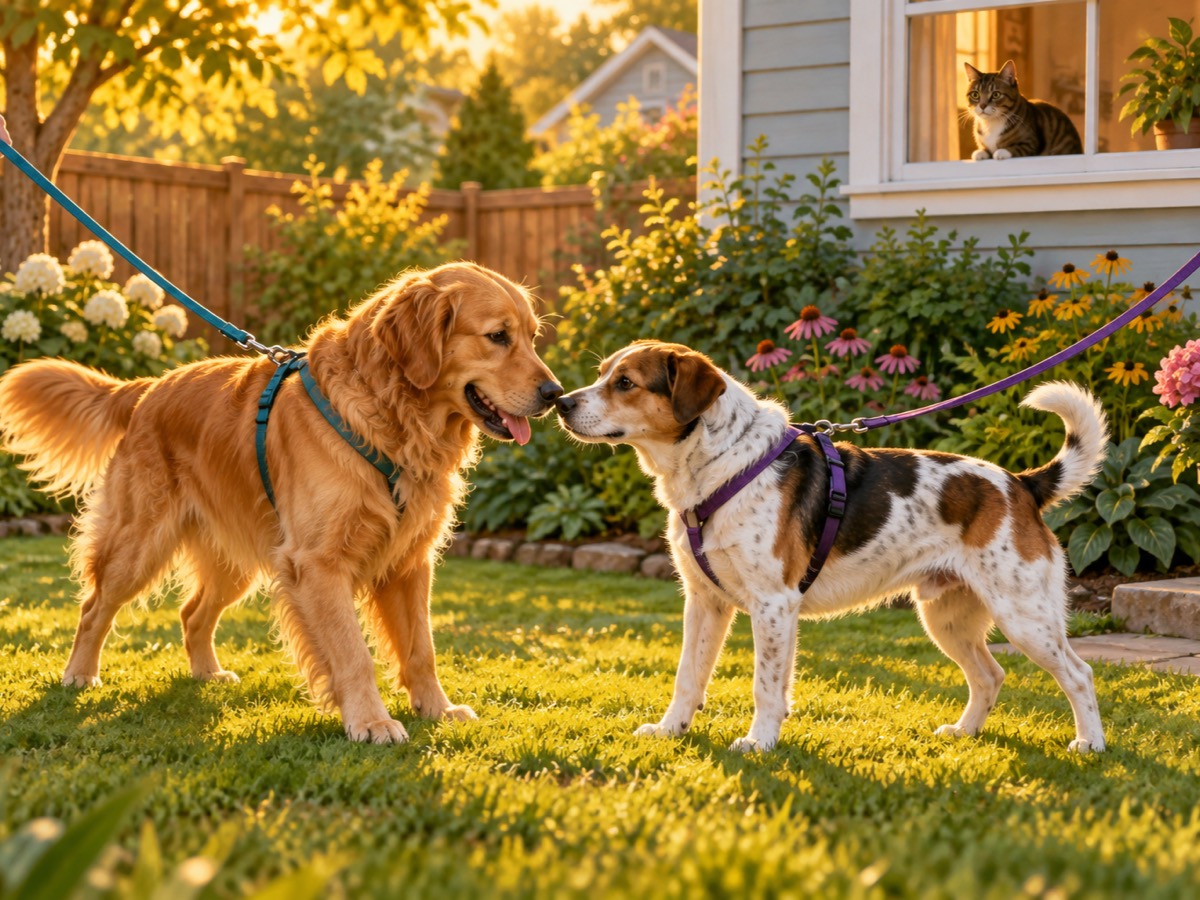
- Back-clip harnesses attach between the shoulder blades. They are comfortable, easy to put on, and take all pressure off the neck. They also give you the least steering power, and on a committed puller they can encourage forward drive the way a sled dog rig does. Best for dogs who already walk nicely, and for small dogs where control is not the issue.
- Front-clip harnesses attach at the chest. When the dog pulls forward, the leash turns them gently back toward you rather than letting them power ahead. This is the most useful single upgrade for a dog who pulls, because it buys you enough control to actually practice loose-leash walking instead of just surviving the walk. Watch that the chest strap sits across the breastbone rather than cutting across the front of the shoulders, since a poorly positioned strap restricts the gait.
- Dual-clip harnesses have both attachment points, and paired with a double-ended leash they give you the most control of anything short of a head halter. Good for a strong adolescent dog in a busy environment.
- Step-in versus over-the-head is a comfort question, not a safety one. Dogs who dislike anything passing over their face accept a step-in style much faster.
Whatever style you pick, fit is what makes it safe. You want two flat fingers under every strap, no gap wide enough for a shoulder to slip through, and no strap sitting directly in the armpit where it will rub. Check the fit again every few weeks on a growing puppy, and after any significant weight change in an adult.
Leashes: length is the decision
Most people own one leash and use it for everything. Two or three, matched to the situation, work far better.
- A four to six foot leash is the workhorse. It is the right tool for sidewalks, training classes, vet waiting rooms, and anywhere with traffic or crowds. Six feet gives the dog room to sniff; four feet keeps them close in tight spaces.
- A long line of fifteen to thirty feet is for open fields, hiking, sniffing walks, and recall practice. Clip it to a harness rather than a collar, never let it wrap around your legs, and stay aware of where the slack is.
- Retractable leashes deserve their own paragraph, below.
- A double-ended leash with clips at both ends lets you use a dual-clip harness, adjust length on the fly, or go hands-free around your waist.
The American Kennel Club is direct about retractable leashes: when a dog hits the end of one at speed, they can suffer injuries including a damaged trachea or spine. Thin cord versions can also cut and burn hands and legs, and a dropped handle clattering behind a dog can frighten them into bolting. The AKC suggests limiting them to open spaces with no other dogs or people around, choosing tape rather than cord, and using a standard six-foot leash anywhere close control is needed. A dog should also already have solid leash manners and a reliable recall first.
A two-minute gear check
Run through this once a month, and always before a trip.
- Squeeze every plastic buckle and check for hairline cracks, which is where failures usually start.
- Look at the stitching where the clip attaches to the leash, and at any point where webbing has frayed.
- Open and close the leash clip several times to confirm the spring still snaps shut.
- Re-check harness and collar fit with the two-finger test.
- Confirm the ID tag is legible and the phone number on it is current, and that your microchip registration is up to date.
Seasonal conditions change the calculus too. Hot pavement, road salt, and reduced daylight all affect what you clip on and when you walk, which our guide to adapting your pet’s routine for summer and winter gets into. Reflective webbing or a clip-on light is worth it for anyone walking before sunrise or after dusk.
If you only change one thing, make it this: match the attachment point to the dog in front of you. A front-clip harness on a puller, a martingale on an escape artist, a plain flat collar and six feet of leash on a dog who has already learned to walk beside you. Good gear does not train a dog, but the wrong gear can quietly make training harder for years.