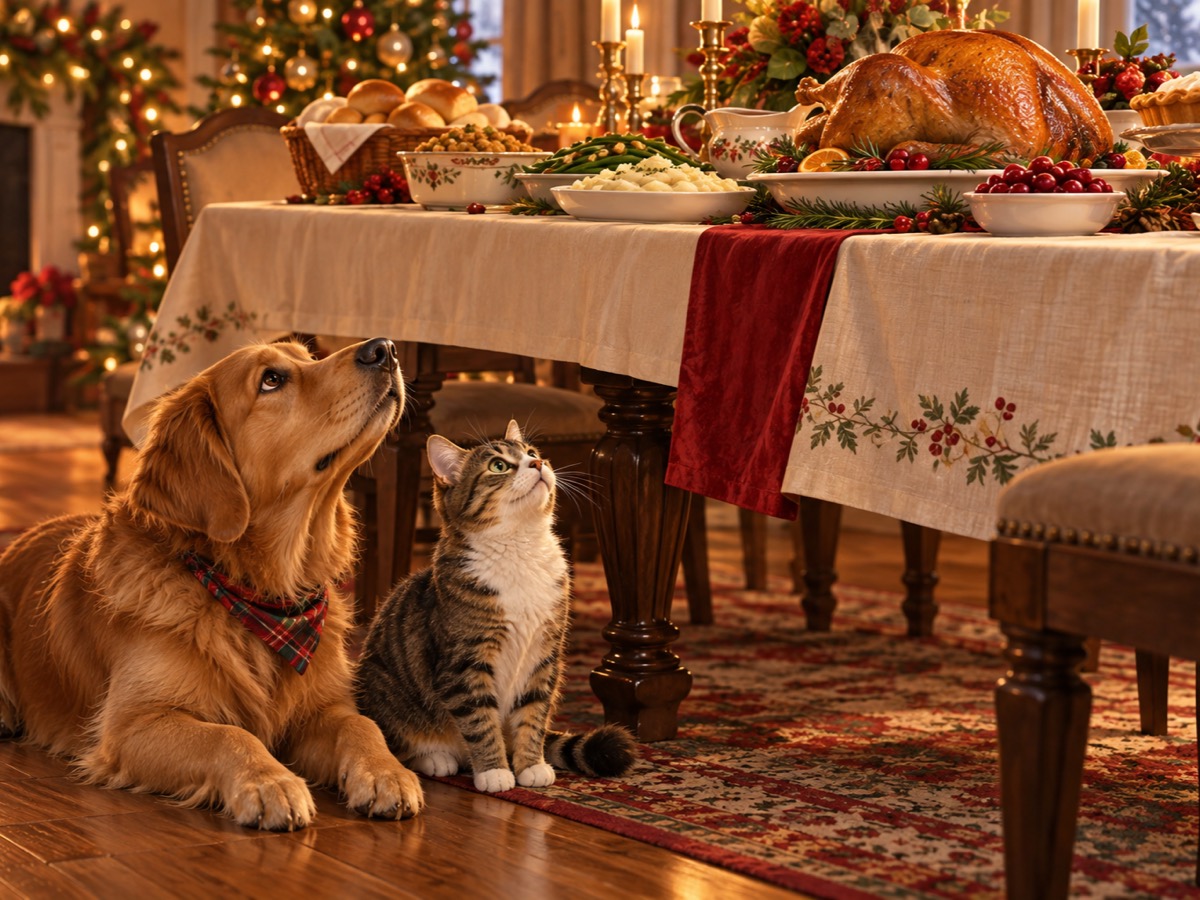
Holiday poisonings rarely happen because someone deliberately fed the dog something stupid. They happen because there is more food in the house than usual, it is sitting at nose height, and there are guests who do not know the rules. A cake cooling on a low table, a handbag with sugar-free gum in it, a plate of leftovers scraped straight into a reachable bin — that is the pattern, and it repeats every festive season in every country.
The good news is that the genuinely dangerous list is short and easy to memorize. Here is what veterinary and poison-control sources actually warn about, why each one matters, and exactly what to do if your pet gets to something.
Chocolate, coffee and cocoa
Chocolate is the classic holiday poisoning, and the reason is a group of compounds called methylxanthines — the same family as caffeine. Dogs and cats process them far more slowly than we do, so they build up.
The ASPCA lists the signs as vomiting and diarrhea, panting, excessive thirst and urination, hyperactivity, abnormal heart rhythm, tremors, seizures, and in serious cases death. Coffee, coffee grounds, espresso beans and caffeine tablets do the same thing.
Not all chocolate carries the same risk. Concentration rises as you go darker: white chocolate contains the least methylxanthine, while baking chocolate and cocoa powder are the most concentrated. A dog that raids a bag of cocoa powder is in far more trouble than one that licks a milk-chocolate wrapper — but body weight matters too, so a small dog and a tiny amount can still be an emergency. Do not try to do this maths yourself while your dog is unwell. Call someone.
Xylitol, the one most people miss
Xylitol is a sugar substitute that is harmless to humans and dangerous to dogs. The AVMA notes it can cause hypoglycemia — a crash in blood sugar — and liver failure in dogs that eat a toxic amount, with signs including vomiting, weakness, lethargy, trouble walking and seizures. Dogs are the species most susceptible.
What makes xylitol dangerous is not the toxicity so much as where it hides. It turns up in things nobody thinks of as food risks:
- Sugar-free gum and mints, often loose in a coat pocket or handbag left on the floor
- Sugar-free sweets, chocolate and baked goods, including “keto” and diabetic-friendly ranges
- Some peanut and nut butters — read the label before you put any nut butter in a food toy
- Some toothpastes, mouthwashes, chewable vitamins and medications
Guest bags and coats are the single most common route. If you are hosting, give visitors somewhere to put their things that a dog cannot get into, and say why. People take it seriously when you explain it.
Grapes, raisins and the dried fruit in everything
Grapes and raisins can cause kidney damage in dogs, and even a small quantity can be enough. Researchers have pointed to tartaric acid as the likely culprit, since dogs do not process it well. There is no known safe amount you can rely on.
The holiday problem is that raisins and sultanas are hidden inside things: fruit cake, mince pies, stollen, panettone, trail mix, granola, chin chin and biscuit assortments, stuffing, and the fruit bowl on the coffee table. Treat any dried-fruit baked good as off-limits, and assume an unattended plate will be investigated.
Nuts belong in this section too. Macadamia nuts specifically cause weakness, incoordination, depression, vomiting, tremors and raised body temperature in dogs, usually showing up within twelve hours. Other nuts are high in fat and can trigger vomiting, diarrhea and pancreatitis, and larger ones are a choking and obstruction risk.
Onions, garlic, alcohol and raw dough
Onions, garlic, leeks and chives cause gastrointestinal irritation and red blood cell damage that can lead to anemia. Cats are particularly sensitive. The catch is that these ingredients are rarely served on their own — they are in the gravy, the stuffing, the stew base, the jollof, the seasoning powder and the pan drippings. “I only gave him a little gravy” is a common start to a bad evening.
Alcohol causes vomiting, diarrhea, incoordination, depression, difficulty breathing, tremors and, at higher doses, death. Pets are small, and a half-finished glass left on a low table is easy to reach.
Raw yeast dough is a double hazard that surprises people. In the warmth of a stomach it keeps rising, producing gas that painfully distends the stomach, and the fermenting yeast produces ethanol — so the animal gets alcohol poisoning at the same time. Let dough rise somewhere genuinely inaccessible, never on a low counter under a towel.
The things that are not toxic but still land pets at the clinic
Plenty of festive emergencies involve nothing on the poison list at all.
- Rich, fatty scraps. Skin, trimmings, drippings and buttery leftovers can trigger pancreatitis, which is painful and sometimes serious. Dogs already prone to it are at higher risk.
- Cooked bones. They splinter. Fragments can lodge in the mouth or throat, perforate the gut, or cause an obstruction.
- Skewers, string and foil. Meat-soaked string and roasting twine are extremely attractive and can cause severe internal damage. Cats are especially drawn to string.
- Salt and salty snacks. Large amounts cause excessive thirst and urination and, at high doses, seizures.
- Bin raids. Mouldy food can contain toxins that cause tremors. Use a bin with a lid your pet cannot open, and take rubbish out on the day.
- Too much of anything new. A sudden pile of unfamiliar food upsets most digestive systems. If you want to include your pet, a small portion of plain unseasoned meat is plenty — and keep to their normal routine otherwise, as we cover in our guide to portions and feeding schedules.
If your pet eats something: what to actually do
Act on suspicion, not symptoms. With several of these, by the time an animal looks unwell the damage is already underway, and early treatment is what changes the outcome.
- Call your vet, your nearest emergency clinic, or an animal poison control service straight away. In the United States, the ASPCA Animal Poison Control Center runs a 24/7 line on (888) 426-4435; a consultation fee may apply. If you are elsewhere, save your own vet’s out-of-hours number in your phone now, before you need it.
- Do not make your pet vomit unless a vet or poison control specialist specifically tells you to. For some substances it makes the situation considerably worse, and home remedies you find online can be harmful in themselves.
- Take the packaging or a clear photo of the ingredient list with you. The specific ingredient and its concentration change the treatment.
- Estimate the amount and the time. “About half a bar, roughly twenty minutes ago” is far more useful than “some chocolate, earlier”.
- Note your pet’s weight and any existing conditions or medications. Dose is relative to body size.
- Keep them calm and contained, and do not offer milk, salt water or anything else to “flush it out”.
Prevention is mostly logistics. Feed your pet before guests arrive so they are not scavenging out of hunger, agree a household no-scraps rule and tell visitors about it once, out loud, rather than hoping. Give a nervous or food-focused animal a quiet room with water, a bed and a food puzzle rather than leaving them to work the crowd. Keeping worked examples of pet first aid in your head helps too — our guide to pet first aid basics covers what to have ready before an emergency, and preventive care is the wider habit that catches problems early. A festive season where nothing happens is the goal, and it is mostly won before anyone sits down to eat.