
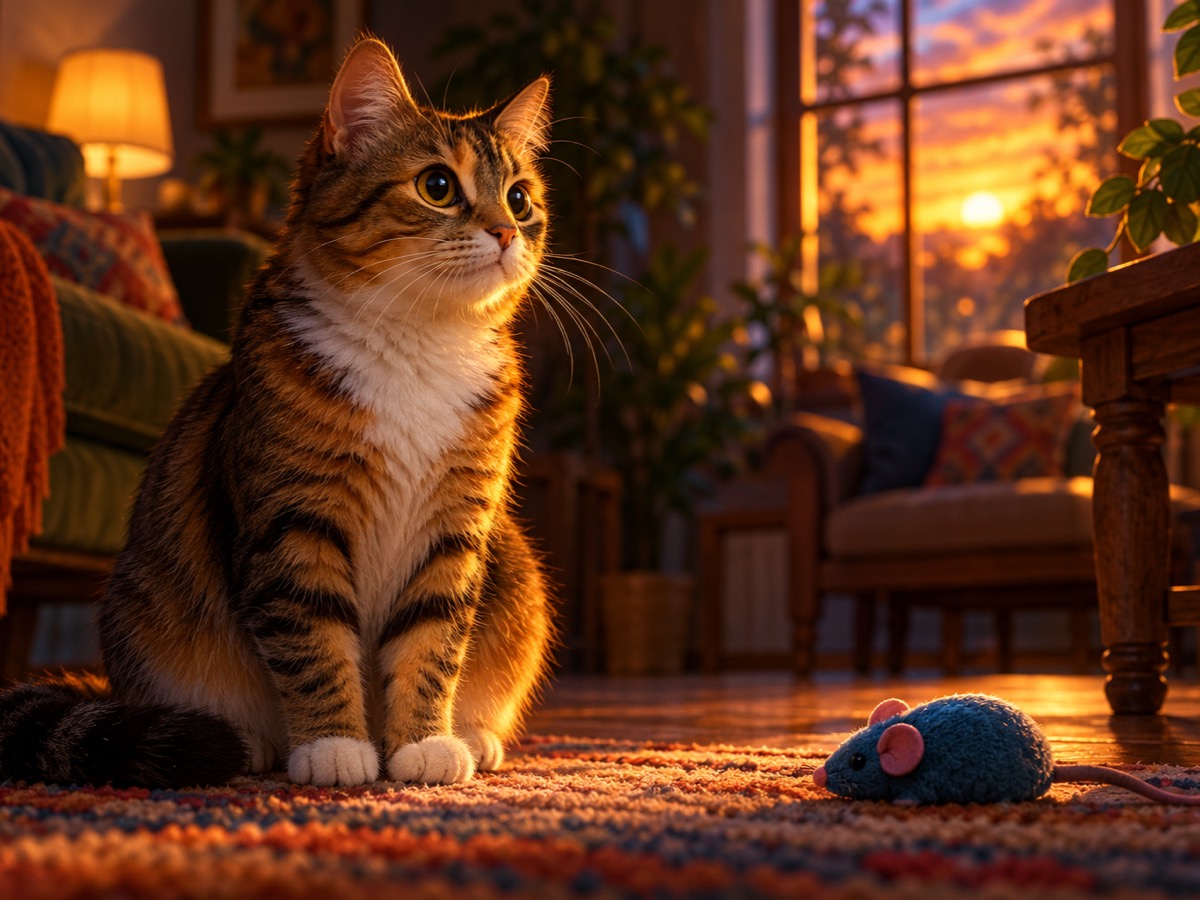
Your cat is looking at the same room you are and seeing something quite different. Dimmer colours, blurrier edges, a wider sweep of the world, and movement you would miss entirely.
Feline eyes are not worse than ours. They are built for a different job: finding small moving animals at dusk. Every advantage they have comes with a trade-off, and the trade-offs explain a surprising amount of everyday cat behaviour.
Colour: two cones, not none
The claim that cats see in black and white has been dead in the veterinary literature for decades and is still repeated constantly. Cats are dichromatic. They have two populations of cone photopigment, with peak sensitivities at roughly 440 and 555 nanometres, against our three.
In practice that means blues come through clearly, while reds, greens, and yellows are hard for a cat to tell apart. A red toy on green grass is a contrast problem for your cat in a way it is not for you. If you have ever wondered why a cat ignores an expensive toy and obsessively hunts a dull blue bottle cap, colour may be part of the answer. Their closest human analogue is red-green colour blindness, though the comparison is rough rather than exact.
There may be something at the other end of the spectrum too. Douglas and Jeffery, publishing in Proceedings of the Royal Society B in 2014, measured lens transmission in 38 mammal species across 25 families and found that cats, along with dogs, ferrets, and hedgehogs, have lenses that let through a meaningful amount of UVA light. The authors argued these species may therefore be UV-sensitive even without a dedicated UV visual pigment. That is a conclusion about optics, not about behaviour, and nobody has demonstrated what a cat does with UV information. File it as intriguing and unfinished.
Built for dusk
Where cats genuinely beat us is low light, and they get there by stacking several adaptations.
- More rods. Rods handle dim light and motion. Peripheral rod concentration in the cat retina runs around five times that of a human retina.
- Bigger optics. Feline corneas and pupils are roughly 50 percent larger in diameter than ours, which simply admits more light.
- A mirror behind the retina. The tapetum lucidum sits in the choroid and bounces unabsorbed light back through the retina for a second chance at being detected. It is also why your cat’s eyes flash green in a photograph.
Put together, cats can detect light about six times dimmer than the faintest a human can register. What they cannot do is see in total darkness. No amount of rod density creates photons, and a cat in a genuinely lightless room is navigating by whiskers, memory, and hearing rather than sight.
The price: everything is a little blurry
Here is the figure that surprises people. Feline visual acuity is commonly given as about 20/150, against 20/20 for a human with good eyesight. Dogs sit around 20/75 and horses around 20/33. A cat has to be more than seven times closer to an object than you do to resolve it as sharply.
Two things cause that. The maximum cone concentration in the feline retina is roughly one-eighth of a human’s, and fewer cones in the high-resolution zone means less fine detail. And the tapetum that buys night sensitivity scatters light inside the eye on its way back out, which degrades resolution. At night that scatter costs almost nothing. In bright daylight it is a genuine handicap.
So your cat does not recognize you across the garden by your face. She recognizes your outline, your gait, your voice, and your smell. That is not a deficiency; it is a different sensory priority, and it reframes a lot of what looks like aloofness.
Movement, flicker, and staring at nothing
A rod-dominated retina is a motion detector. Cats pick up small, quick movement at the edge of the visual field extremely well, which is exactly what you want if your living depends on noticing a mouse twitch in long grass. It is also why a still toy is invisible to a cat’s interest and the same toy dragged erratically becomes irresistible.
Flicker perception is often bolted onto this, with confident claims that cats see televisions as strobing. The underlying physiology is real: human cone responses fuse at around 45 Hz, which is why a 60 Hz screen looks continuous to us, and cone responses in various other species fuse higher, in the region of 70 to 80 Hz. The veterinary source for those numbers does not give a cat-specific figure, and the various numbers circulating online for cats do not trace cleanly back to a measurement. The general point stands, that some animals can perceive flicker we cannot, but be wary of anyone quoting an exact feline frame rate.
And the staring. A cat fixed on a blank wall is usually tracking something auditory rather than visual, since feline hearing extends well above our range and their ears can orient independently. Occasional staring is normal. Persistent staring combined with disorientation, circling, or pressing the head against surfaces is not, and warrants a veterinary visit.
A wider world, with a hole in it
A cat’s total visual field is about 200 degrees, compared with roughly 180 in humans. Within that, one veterinary account describes a frontal binocular field of about 140 degrees plus two lateral monocular fields of about 30 degrees each. Be aware that published figures for binocular overlap vary: other sources put it nearer 130 or even 120 degrees. The consistent finding is the wider total field, not the precise overlap.
Forward-facing eyes with substantial overlap are the predator arrangement, and they support the depth judgement a cat needs to pounce accurately or land on a narrow shelf. The cost is a large blind area behind the head, which is part of why cats dislike being approached from behind and why startling a sleeping cat from the rear goes badly.
There is also a close-range blind spot. You will see a specific number quoted for how near a cat can focus, often around 25 centimetres, but that figure is hard to trace to a primary measurement and is better treated as unverified. What is well established is that cats locate food and objects right under the nose by touch and smell, which is what those forward-facing whiskers are for. Watch a cat lose a treat directly beneath its chin and you can see the handover from eyes to whiskers happen in real time.
Living with a cat’s eyes in mind
Some practical consequences follow directly from all this. Approach a cat from the front or side, within the visual field, rather than from behind. Pick toys with movement and contrast rather than clever colours, and pick blues over reds if you want a toy a cat can actually see against your carpet. Leave a nightlight if an older cat is navigating stairs after dark, since night sensitivity declines with age and cataracts.
Build vertical space, because a cat whose depth perception and peripheral motion detection are this good gets real satisfaction from surveying a room from height. That is one of the most reliable wins in indoor enrichment, and it costs nothing but a shelf.
Most of all, remember that vision is not your cat’s main channel. Scent and hearing carry more of the load, and the signals she sends back are mostly postural rather than visual. Reading those properly will tell you more about what your cat is thinking than any amount of eye contact.