Ask around Lagos or Abuja about which dog to get and you will hear a shortlist built almost entirely on status. Caucasian Shepherd. Samoyed. Rottweiler. Boerboel. What you will rarely hear is the question that should come first: can this animal actually cool itself down in a place where the temperature and the humidity are both high for most of the year, and where the power can go off for hours at a stretch?
A dog does not sweat the way you do. It offloads heat mainly by panting, moving hot air across wet surfaces in the mouth and airway, plus a little through the paw pads. That system works well in dry heat and badly in humid heat, because evaporation slows down when the air is already saturated. Anything that narrows the airway or insulates the body makes it work worse still. That single piece of physiology decides more about whether a dog thrives in Nigeria than any breed reputation does.
Judge the traits, not the breed name
Before you think about specific breeds, learn what to look at. Veterinary guidance on hot-weather breeds is consistent about which physical features help and which hurt.
- A long muzzle. The longer the nose, the more surface area for evaporative cooling when the dog pants.
- A short, single coat with little or no dense undercoat, so air can move against the skin.
- Upright, thin, generously sized ears, which shed heat far better than heavy floppy ones.
- A lean, moderate build. Bulk holds heat, and a heavy or obese dog overheats faster than a fit one.
- Lighter coat color, which reflects rather than absorbs sun.
The opposite list is just as useful. A flat face, a thick double coat built for a cold winter, heavy muscle mass and a dark coat all stack the odds against a dog here. Two of those in the same animal is a serious problem. Three is a dog that will need managed indoor cooling for its whole life, and that is a promise your generator has to keep, not just you.
The dogs that genuinely suit this climate
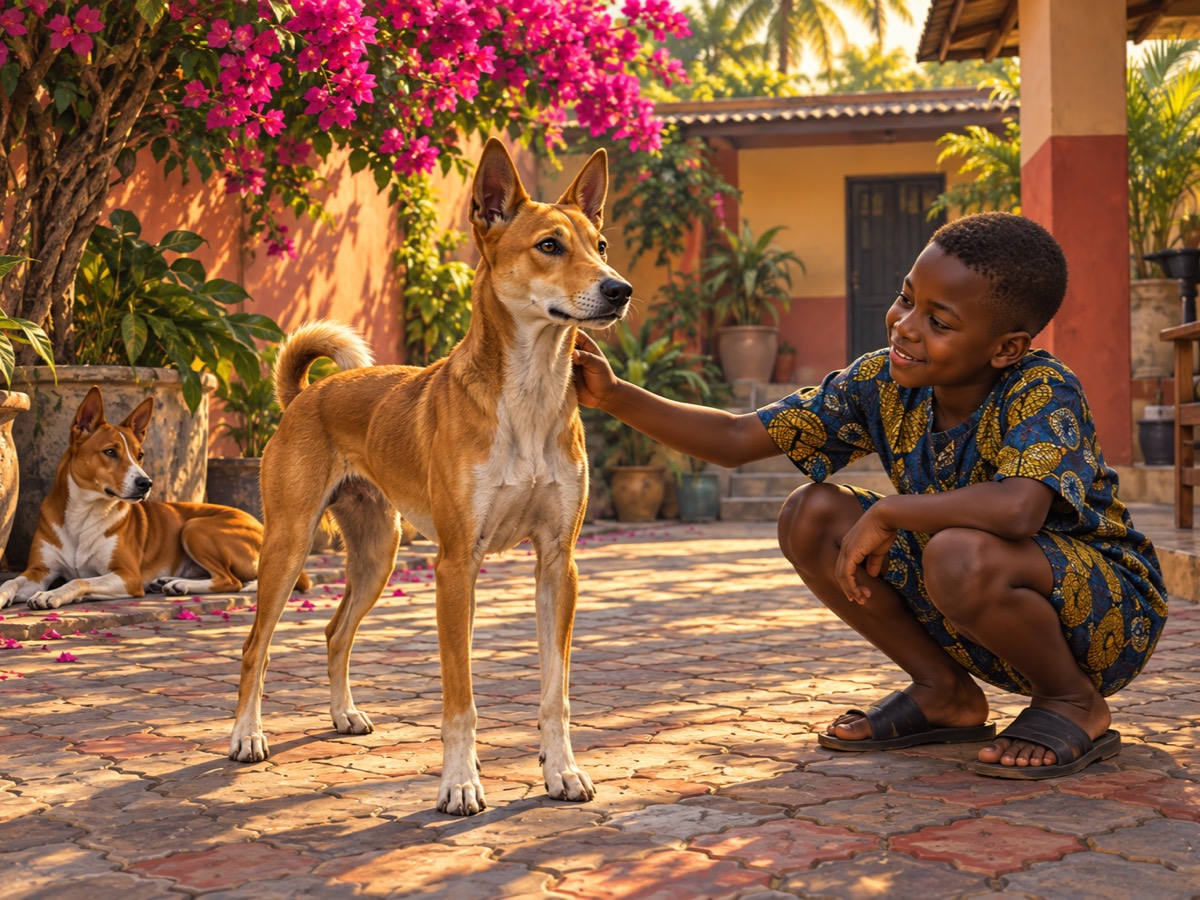
Start with the obvious one that most people overlook. The Nigerian local dog, the one called ekuke or bingo depending on where you grew up, is the single best-adapted dog in the country. Generations of natural selection in this exact climate produced a lean, short-coated, prick-eared, long-nosed animal with a robust constitution and a low tendency toward the inherited joint, breathing and skin problems that plague heavily bred exotics. They are alert, they are quick, and they cost you nothing at the gate.
The prejudice against them is a status prejudice, not a practical one. If you want a dog that will still be walking comfortably at ten years old on a normal Nigerian household budget, the local dog is the strongest candidate on the list, and there are thousands of them looking for homes right now through the adoption finder.
Beyond that, several established breeds are genuinely built for heat.
- Basenji. An African sighthound-type breed with a fine short coat, upright ears and almost no doggy odor. Independent and clever to the point of being stubborn, and a determined escape artist, so fencing matters.
- Greyhound and Whippet. Thin-coated, long-nosed and, contrary to the racing image, calm indoor dogs who sprint briefly and then sleep. Whippets in particular suit apartments well.
- Dalmatian and other short-coated pointer types. Active, need real daily exercise, but they cool efficiently.
- Doberman and other short-coated guarding breeds, if you want protection without a heavy coat. They still need shade and water discipline, but they are far better placed than the plush-coated guardians.
- Sensible mixed-breed dogs of moderate size. A mongrel with a long nose and a short coat is often the healthiest dog on the street.
The popular choices that fight the climate
This part is uncomfortable, because these are the dogs people spend the most money on. Say it plainly anyway.
Thick-coated northern and mountain breeds, the Samoyed, the Caucasian Shepherd, the Husky, the Saint Bernard, carry insulation designed for a cold winter. Vets consistently list dense double coats among the main risk factors for heatstroke, alongside short muzzles, excess weight, age and existing heart or airway disease. Keeping one of these dogs well in the tropics is possible, but it is genuinely hard work and it depends on reliable cooling. If your dog’s welfare fails whenever NEPA fails, you have designed a fragile system.
Flat-faced breeds are the other group to think hard about. Pugs, French and English Bulldogs, Boxers and Shih Tzus have shortened airways, so the very mechanism they rely on to cool down is already compromised on a normal day. In humid heat that margin disappears fast. These dogs also tend to struggle with skin fold infections in humidity, which is a recurring vet cost rather than a one-off.
The big guarding breeds sit in the middle. A Boerboel is African in origin and short-coated, which helps, but it is a heavy, muscular dog that generates a lot of heat and needs serious handling and training. A German Shepherd’s double coat is a real disadvantage here, though the breed manages better than the mountain guardians. If you go this route, go in knowing the shade, water and exercise-timing discipline you are signing up for, and read our guide to caring for dogs in Nigeria’s heat before the dog arrives, not after.
Match the dog to your actual home
Climate is only half the equation. The other half is the space and the routine you really have, not the one you imagine you will have once things calm down.
If you live in a flat with no compound, you need a dog whose exercise needs you can meet with early morning and evening walks, and whose barking will not put you at war with the neighbors. A Whippet or a calm medium mixed-breed fits. A working-line German Shepherd with nowhere to work does not, and the resulting frustration comes out as destruction and noise. Our guide to building a pet-friendly Nigerian apartment covers the practical side of that.
If you have a compound, ask honestly whether the dog will live outside all day. A dog kept alone on a chain in a compound is not a well dog, whatever its breed. Shade that moves with the sun, constant clean water, and real contact with the family are the minimum, and any dog will need somewhere genuinely cool to lie down during the afternoon.
Then think about the next fifteen years. Grooming a heavy coat costs money and time forever. A large dog eats more, is harder to move to a vet, and is more expensive to treat. A guarding breed you cannot control is a liability to your visitors and your household staff. Our broader guide to choosing the right breed for your lifestyle is worth reading alongside this one.
The best dog for a Nigerian home is usually a moderate-sized, short-coated, long-nosed dog with upright ears and no exotic price tag. That description fits the local dog perfectly. It is not a downgrade. It is the answer the climate has already worked out.