
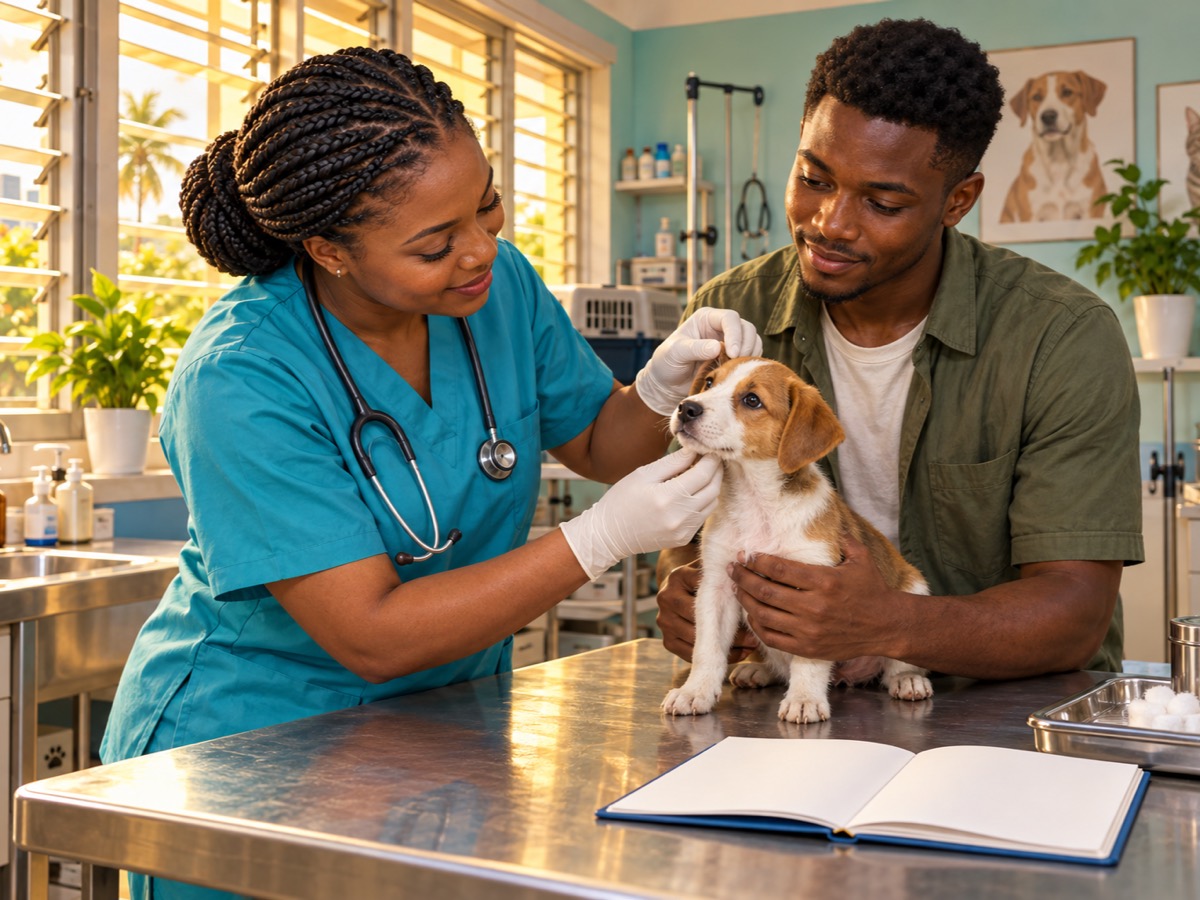
Most people who bring a puppy or kitten home in Nigeria get vaccination half right. They take the animal for one injection, someone writes something in a card, and everyone assumes the job is done. Then the puppy dies of parvovirus at fourteen weeks, or a family spends a frightening month after a bite from a dog nobody can account for.
The problem is almost never bad intentions. It is that vaccination is a course, not an event, and the timing of that course is dictated by biology rather than convenience. Understanding why the schedule looks the way it does makes it much harder to accidentally skip the dose that mattered.
Why the timing is what it is
A newborn puppy or kitten absorbs antibodies from its mother’s first milk. Those maternally derived antibodies protect it in early life, and they also block vaccines from working, because they neutralize the vaccine the same way they would neutralize the real virus.
Those antibodies fade at different times in different animals, anywhere from around six weeks to sixteen weeks or later, and you cannot tell by looking which animal is which. That is the whole reason for repeat doses. You are not “topping up” immunity. You are giving several chances to catch the moment when the mother’s antibodies have faded enough for the vaccine to take, but before the animal is fully exposed.
The World Small Animal Veterinary Association, whose vaccination guidelines are the global reference point for small animal practice, recommends starting the core series at six to eight weeks of age and repeating every two to four weeks until the final dose falls at sixteen weeks of age or older. That last part is the one people cut short, and it is the one that matters most. A course that finishes at twelve weeks leaves a real window of vulnerability.
Core vaccines: what every dog and cat needs
Core vaccines are the ones recommended for every animal everywhere, because the diseases they prevent are severe, widespread, and in some cases transmissible to people.
- Dogs: canine distemper virus, canine adenovirus, and canine parvovirus. These are usually given together in a combination shot.
- Cats: feline panleukopenia virus, feline herpesvirus type 1, and feline calicivirus, again normally combined in one injection.
- Both: rabies, which WSAVA treats as core in every part of the world where rabies is endemic. Nigeria is one of those places.
Parvovirus deserves a specific mention because it is the disease that kills the most Nigerian puppies. It is brutally hardy in the environment, it survives on soil and shoes and compound floors for months, and it kills through violent vomiting and bloody diarrhea. Treatment means intensive fluid support and it is expensive and often unsuccessful. Prevention is a series of injections. That asymmetry is the entire argument.
Rabies, and why it is not optional here
Rabies is endemic in Nigeria and is effectively always fatal once symptoms appear in a person. Dog bites are the main route of human infection, which makes your dog’s vaccination status a household safety measure as much as a pet health measure.
Be clear-eyed about the national picture. Published research on rabies control in Nigeria describes national dog vaccination coverage far below the seventy percent that the World Health Organization considers necessary to interrupt transmission, and notes that a functioning national rabies control program has not been in place. Vaccination drives happen, often around World Rabies Day and often run by veterinary associations, universities, state authorities or non-profits, but coverage is patchy and inconsistent.
Rules also vary by state and local government, and enforcement varies even more, so do not rely on a blogger’s description of the law, including this one. Ask your vet what your state currently requires, particularly if you plan to travel with the animal, board it, or move it between states. What is not in doubt is the veterinary and public health advice: vaccinate against rabies, keep the record, and repeat it as your vet directs.
Cats need it too. A cat that goes outside at all is exposed, and cat bites and scratches are a genuine transmission route that people take far less seriously than dog bites.
Non-core vaccines: a conversation, not a default
Non-core vaccines are recommended based on where the animal lives and how it lives, rather than for every animal automatically. Availability in Nigeria varies considerably between practices and cities, so this is genuinely a discussion with your vet.
- Leptospirosis for dogs, which is worth raising if you have rats around, if your area floods, or if your dog has access to standing water. It is a strong candidate in many Nigerian compounds.
- Bordetella and canine parainfluenza, relevant if your dog will be boarded, groomed in a busy salon, or mixing regularly with other dogs.
- Feline leukemia virus for cats, particularly young cats with any outdoor access or contact with cats of unknown status.
Bring your actual lifestyle to the appointment. A vet cannot risk-assess an animal they know nothing about, and “she stays inside” means something different in a flat than in a compound with an open gate.
After the puppy or kitten course
The series does not end at sixteen weeks. Current WSAVA guidance recommends a further core dose at around six months of age, earlier than the traditional one-year booster, specifically to close the gap for animals whose maternal antibodies were still interfering at the last kitten or puppy dose.
After that, adult core vaccination for the main viral diseases is generally recommended no more often than every three years, because immunity to those particular vaccines is long-lasting. Rabies and the non-core vaccines follow their own intervals, which depend on the specific product used, so your vet’s instruction beats any general rule. Adopting an adult animal of unknown history does not mean starting from scratch in the same way; ask your vet what an unvaccinated adult needs, since it is usually a much shorter course than a puppy’s.
None of this replaces an annual health check. The yearly visit is worth keeping even in a year with no vaccine due, because it is where weight, teeth, joints, heart and skin get looked at by someone trained to notice.
Making the schedule survive real life
Between traffic, work and clinics that may be a long drive away, the practical failure mode is not refusal. It is drift. A dose gets pushed by two weeks, then three, and then it never happens.
- Book the next appointment before you leave the clinic, and put it in your phone with a reminder a few days ahead.
- Keep the vaccination card, and photograph it after every visit so a lost card is not a lost history.
- Ask what was actually given, including the product name and batch, and check it is written down.
- Ask about the cold chain. Vaccines are heat-sensitive, and in a country with unreliable power that is a fair question. A good clinic will not be offended by it.
- Confirm the practitioner is registered with the Veterinary Council of Nigeria. Vaccines administered by unregistered sellers of uncertain stock are a common and serious problem.
- Keep the puppy off shared ground and away from unknown dogs until the course is complete, since that gap is when parvovirus does its damage.
If you are about to make that first appointment, our guide to preparing for a first vet visit covers what to bring and what to ask, and finding a good vet walks through how to judge a practice. For the wider disease picture that vaccination only partly covers, read our overview of common pet health risks in West Africa.