Holiday travel is stressful enough without a stack of unknowns attached to your dog or cat. Almost every problem people hit on the road with a pet is a planning problem, and planning problems get solved weeks in advance rather than at the departure gate.
Should they come at all?
Wanting your animal with you is not the same as it being good for them. Be realistic about your specific pet.
- Most cats are strongly territorial and cope far better in a familiar home with a visiting sitter than in a car for eight hours and then a house full of strangers.
- Very young, very old, pregnant or unwell animals travel poorly, and stress can worsen an existing condition.
- Flat-faced breeds — pugs, bulldogs, boxers, Persian cats — have compromised airways, which makes heat, stress and confinement genuinely riskier for them.
- An anxious traveler who drools, vomits or panics in the car needs work on that problem long before the trip, not a longer trip.
If the answer is that they stay home, arrange care properly: a trusted sitter, or a boarding facility you have visited in person and booked early, since holiday periods fill up months ahead. Leave written feeding instructions, medication details, your vet’s number and your own.
Two to four weeks out: vet, paperwork, practice
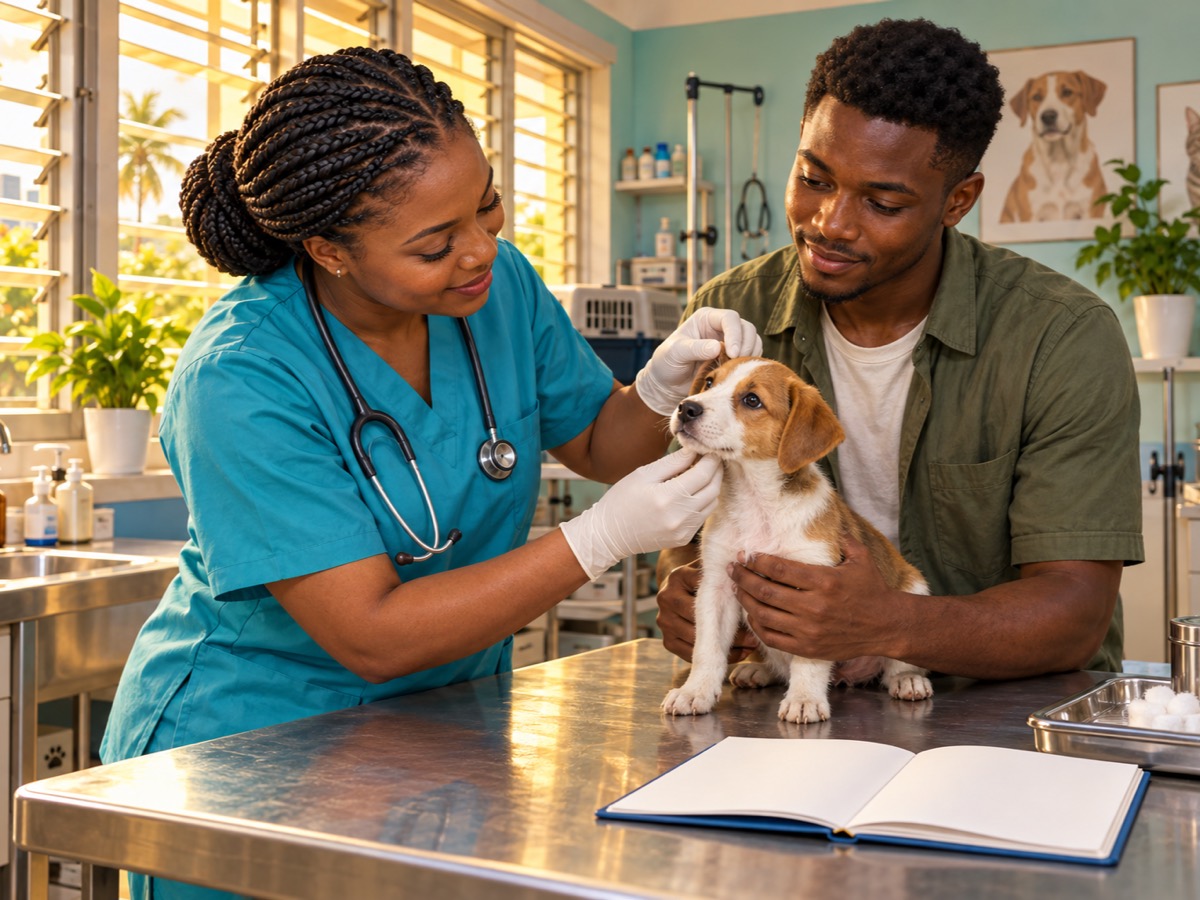
The AVMA advises scheduling a veterinary examination before travel to confirm your pet is healthy enough to go and is protected against diseases common where you are heading. That appointment is also the moment to sort out flea, tick and worm prevention, and to make sure the rabies vaccination is current — it is the one document that comes up most often at borders and boarding kennels alike.
Requirements beyond that vary enormously by destination and change over time. Crossing a state or national border can involve a health certificate issued within a set window before travel, specific vaccinations, parasite treatments, or a microchip meeting a particular standard, and international trips can require months of lead time. Check the official requirements for your exact destination yourself, and tell your vet early — certificates often need an accredited veterinarian and cannot be produced at short notice.
- Confirm your pet’s microchip is registered to a phone number you currently use, and keep a recent photo on your phone.
- Fit a collar with a readable tag, and add a temporary tag with the address you are traveling to.
- Carry vaccination records and prescription details on paper and as photos, and look up an emergency veterinary clinic near your destination before you leave.
- Pack more medication than the trip needs, plus their normal food. A sudden diet change in a stressful week means an upset stomach.
Practice matters as much as paperwork. The AVMA recommends helping pets get used to the crate, carrier or harness they will travel in, with a familiar toy or blanket inside, and giving them experience of shorter car journeys before any long trip. If your pet’s carrier only ever appears before a vet visit, they already have an opinion about it — build a better association now, the way we describe in crate training without tears.
By car: restraint is the whole game
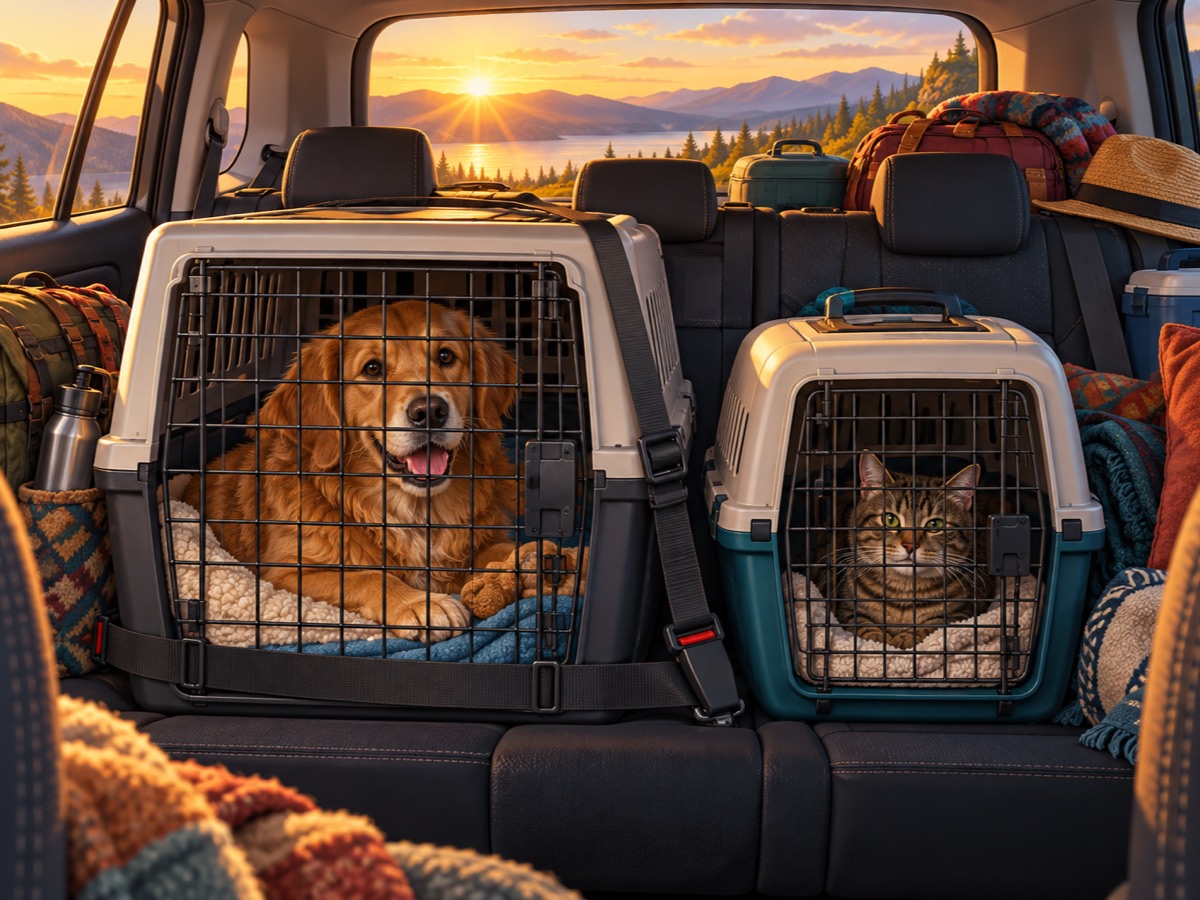
A loose pet in a moving car is a danger to itself and to everyone else in the vehicle. The AVMA’s guidance is that the safest place is the back seat, properly restrained in a crate, carrier or safety harness.
- Choose a crate or carrier big enough for your pet to stand up, turn around and lie down comfortably.
- Position it as near the center of the vehicle as you can, and secure it so it cannot slide or tip.
- If you use a harness, use one designed for vehicles — a walking harness is not the same thing — and look for crash-tested products that work with your seat belt.
- Keep pets out of the front seat, where an airbag can cause serious injury, and never let a dog ride with its head out of the window or in an open truck bed.
For motion sickness, the AVMA suggests avoiding a large meal before you set off and cracking a window so fresh air circulates. Stop every few hours so dogs can stretch, drink and toilet, and always clip the lead on before the door opens — a dog bolting at a rest stop far from home is one of the worst outcomes here. Keep cats in their carrier the entire journey.
One rule with no flexibility in it: never leave a pet alone in a parked vehicle. In warm weather the interior heats to lethal temperatures within minutes even with windows cracked and even in shade, and in cold weather the reverse happens. There is no safe version of “just five minutes”.
By air: confirm everything directly with the airline
Air travel rules for animals differ between airlines, routes, aircraft types and seasons, and they change without much notice. Do not rely on what a friend did last year, or on anything you read online — including here. Call the airline while you are booking and get the details in writing.
- Whether they accept pets at all on your specific flight and date, and whether cabin or hold transport applies to your pet’s size and species.
- Which documents they need, and how recently each must be issued. Health certificates are commonly required and are typically valid only for a short window before travel.
- Whether a health and acclimation certificate is needed for hold transport, which records your pet’s fitness to travel and any temperature limits, and must be signed by your vet.
- Carrier dimensions and construction rules, breed restrictions, temperature embargoes, per-flight booking limits and fees. Flat-faced breeds are restricted or refused by many carriers because of the airway risks.
For hold transport, crates generally must let the animal stand without touching the top, sit up, turn around and lie down comfortably, with flat-faced breeds usually needing a size larger than you would otherwise choose. Book direct flights where you can, avoid the hottest and coldest parts of the day, and get your pet comfortable in the actual crate weeks in advance.
On sedation, the AVMA’s position is that sedatives and tranquilizers should not be given to pets traveling by air unless a veterinarian has determined it is medically necessary. Sedated animals face increased respiratory and cardiovascular risk at altitude, cannot brace themselves if a crate shifts, and regulate their body temperature less well. Flat-faced breeds are at particular risk. This is a conversation with your vet, never a decision you make with something left over in a drawer.
Once you arrive
An unfamiliar house is a new set of hazards and a new set of exits. Spend the first twenty minutes on setup, not greetings.
- Pick one quiet room as your pet’s base, and put their bed, water, food and litter tray there before you let them out of the carrier.
- Walk the space and remove what does not belong within reach: medications in handbags, chocolate and sweets, festive plants, wires, candles and small ornaments. Check gates and doors, and tell everyone not to let the animal slip out.
- Keep feeding and walk times as close to normal as you can. Routine is what makes a strange place tolerable.
- Let your pet approach guests rather than the other way round, supervise children closely, and watch for stress signs — refusing food, hiding, pacing, panting. The answer to those is more quiet time, not more socializing.
If your pet finds any of this hard, that is information for next year rather than a failure — some animals are simply happier at home with someone they know. Our guides to separation anxiety and pet first aid are both worth reading before any trip: one helps you prepare an anxious animal, the other makes small emergencies far less alarming.