Walk into almost any shelter and someone will tell you that the black ones wait the longest. It is one of the most repeated claims in animal rescue, it drives adoption promotions every October, and it turns out to be far less settled than the posters suggest.
The honest version is more interesting than the myth, and more useful if you are trying to help. Here is what the research actually shows, what really drives long waits, and what you can do about it.
What the research on black dogs found
The idea, usually called black dog syndrome, is that dark-coated dogs are passed over and therefore stay in shelters longer. It has been tested directly, and the results have not been kind to it.
One of the larger studies, led by researcher Christy Hoffman, looked at four years of records covering roughly 16,700 dogs at two shelters and found no evidence that black dogs waited longer. If anything the black dogs in that dataset were adopted marginally faster than the average. Other work has found the opposite in different populations, with black dogs staying somewhat longer than multicolored or brindle dogs. Findings vary by shelter, by region, and by year.
So this is genuinely a debated question rather than an established fact. What the studies do agree on is that coat color is a weak factor compared with everything else on the kennel card.
Cats are a slightly different story
The picture for cats is more suggestive, though still modest. A study of nearly 8,000 cats entering a large urban shelter in Kentucky found black cats had the lowest adoption rate and the highest euthanasia rate of any color group, with white cats faring best. The authors were careful about how they framed it: the statistical effect of color overall was small, and they described their results as weak support for what others call black cat bias. Their practical conclusion was still that black cats in public shelters deserve extra rehoming attention.
That same study also punctured a familiar seasonal story. Among more than 1,200 all-black cats, October brought no improvement at all in adoption or transfer rates compared with other months. The Halloween surge in interest, at least in that shelter, did not exist.
What actually keeps animals waiting
Across the research, the factors that consistently predict long stays and poor outcomes have almost nothing to do with color:
- Age. Older animals wait dramatically longer than young ones, and the drop-off starts earlier than most people expect.
- Breed type. Bully-type dogs in one large study waited roughly two and a half to three times longer than average and faced worse outcomes.
- Size. Large dogs sit longer than small ones, partly because of housing and weight limits in rentals.
- Intake circumstances. In the cat study, arriving as a stray was associated with far worse odds than color ever was.
- Medical and behavioral labels, including anything that reads as expensive, contagious, or complicated on a profile.
- Length of stay itself, which becomes self-reinforcing as animals deteriorate in kennels and show worse.
If you want to help the animals who genuinely wait longest, that list is where to aim. A ten-year-old dog, a bully mix, or a cat with a manageable chronic condition is far more overlooked than a healthy young black lab. Our pieces on why senior pets make wonderful companions and adopting an FeLV-positive cat both cover animals that fit that description.
Why the black pet story persists anyway
Even where the outcome data does not support a strong effect, shelter staff are not imagining everything. A few real mechanisms sit underneath the perception.
The clearest one is photography. Black fur absorbs light, and in a dim concrete kennel a black dog or cat frequently photographs as a silhouette with no visible eyes or expression. Since most adopters now shop online first, an animal whose photo shows nothing readable gets fewer clicks, and fewer clicks means a longer wait regardless of what the animal is actually like. Hoffman’s own follow-up work pointed toward black cats receiving fewer online views.
There is also a visibility effect inside shelters. Black animals are physically harder to see at the back of a kennel, especially in low light, so they simply get looked at less. And black is a common coat color, which means a black dog is competing against more animals that look like him in the same listing.
Some of the reported effect may be cultural superstition, particularly around black cats, but the more mundane explanations do most of the work. That matters, because a photography problem has a cheap fix and a superstition does not.
What you can actually do
If you are adopting, the simplest move is to stop filtering by appearance. Search by temperament, energy level, age, and household fit instead of by color or looks, and read the full write-up rather than judging a bad photo. Ask staff which animals have been there longest and why, and go meet the ones who do not photograph well. A black cat in a bright room looks like a completely different animal than the same cat in a kennel photo.
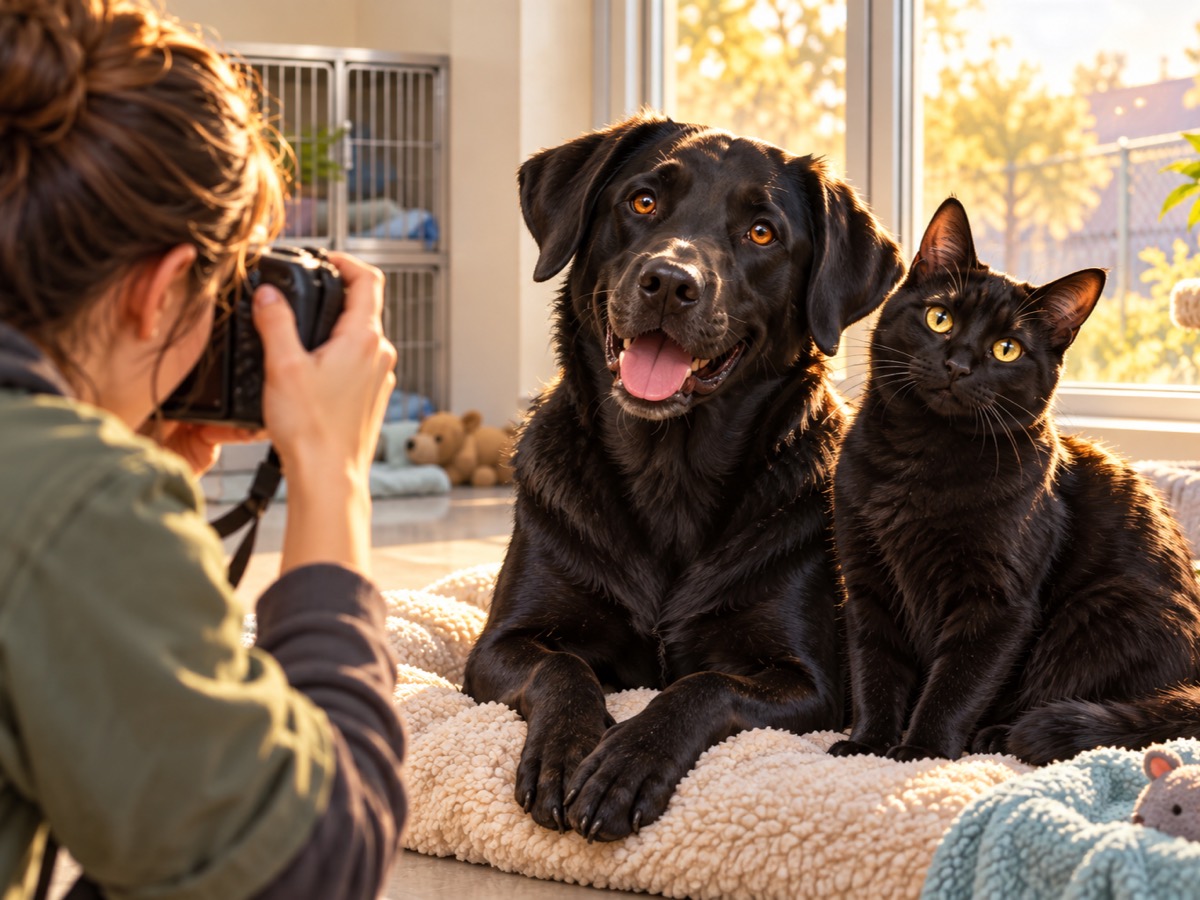
If you cannot adopt, the highest-leverage volunteer job at most shelters is photography. Shoot in daylight or near a window, expose for the animal rather than the background, use a light or contrasting backdrop, get down to eye level, and catch a moment when the eyes are visible and the mouth is relaxed. Good photos of long-stay animals move more of them than any awareness campaign. Writing better profile text, walking dogs so they show calm, and fostering all work on the same lever. Our guide to helping local shelters without adopting has more options.
One caution for anyone running or supporting a shelter: Hoffman’s advice after her study was that organizations should look at their own data before pouring resources into promoting a group that is already being adopted at a normal rate. The animals genuinely stuck in your local shelter may be seniors, large dogs, or bully mixes, not black ones. Ask before you campaign.
None of this means the black animals in your local shelter do not need homes. It means the reason to adopt one is not that a statistic said so. Judge the animal in front of you on temperament and fit, and browse without a color filter in our adoption finder, keeping in mind that each adoption completes directly with the rescue or shelter caring for that animal.