
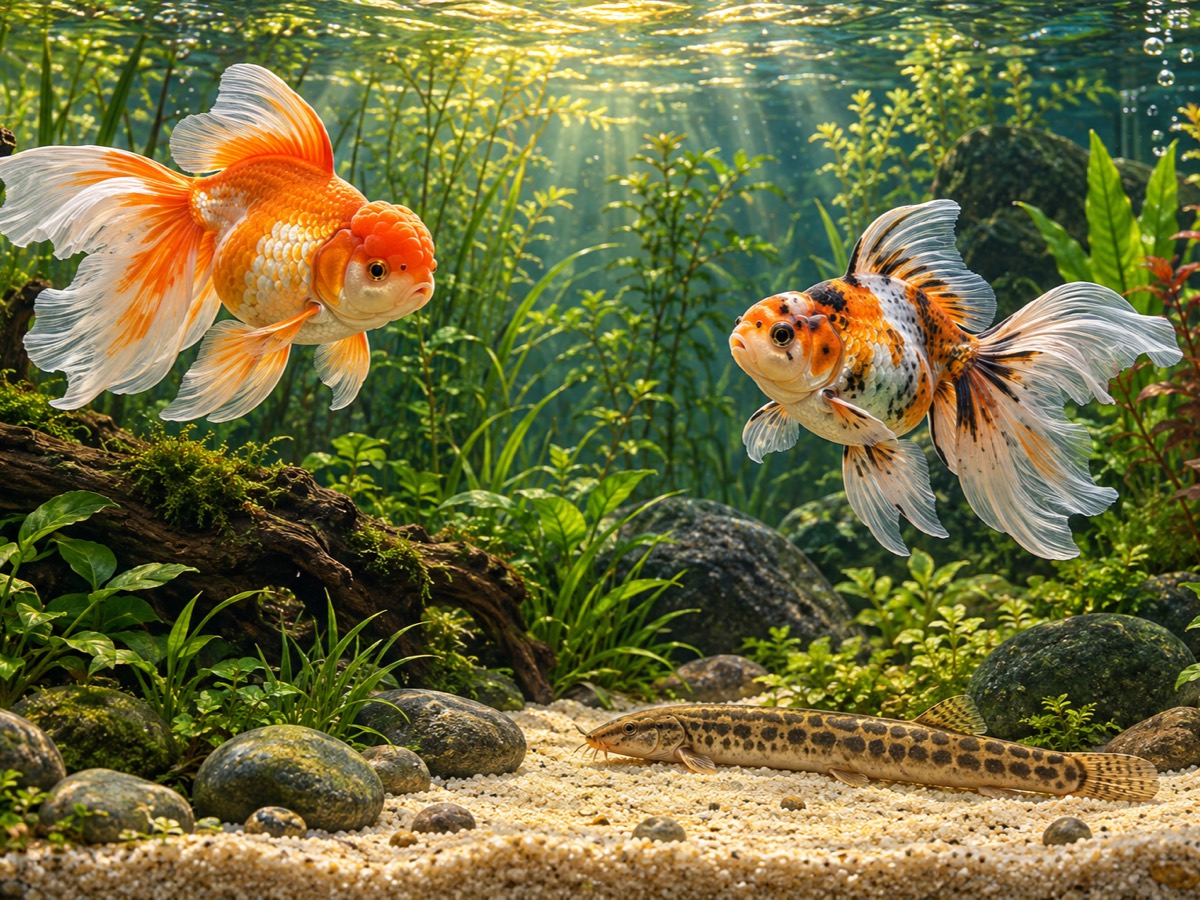
The honest answer to “what can I put in with my goldfish?” is shorter than most people want it to be. The best tankmate for a goldfish is another goldfish. Everything else is a compromise, and a lot of the combinations sold confidently at pet shops are compromises that end with something dead.
That is not fussiness. Goldfish have a specific and unusual combination of requirements that rules out most of the fish sold beside them, and understanding why saves you from a cycle of mysterious losses.
Three things that disqualify most candidates
Temperature. Goldfish are coldwater fish. They do best somewhere around the mid-sixties to low seventies Fahrenheit, with fancy varieties usually kept at the warmer end of that band. Most tropical community fish want the high seventies to low eighties. There is no overlap where both are comfortable, only a middle ground where both are chronically stressed. A fish kept above its metabolic design point burns through its life faster, which is why coldwater species kept in heated tropical tanks tend to die young without ever showing an obvious disease.
Waste. Goldfish are exceptionally messy. They eat a lot, they produce a lot, and they root through substrate stirring up more. Maidenhead Aquatics puts the mismatch nicely, comparing goldfish and tropicals to keeping rabbits in a stable with a horse. The practical consequence is that a filter sized and stocked for delicate tropical fish will be overwhelmed, and the tank will run high on nitrate and dissolved organics even when the water looks clear.
Mouth size and fin shape. Goldfish are not aggressive, but they are indiscriminate. Anything small enough to fit in the mouth of an adult goldfish will eventually be tested, including small fish and most shrimp. Meanwhile the goldfish itself is vulnerable in the other direction: fancy varieties with long flowing fins and poor maneuverability are easy targets for nippy species, and a fancy with damaged fins or a bumped telescope eye is one infection away from a real problem.
Run any candidate species past all three filters before you buy it. Most fail at least one.
Popular suggestions that do not work
These come up constantly, and each has a specific problem:
- Betta fish. Tropical, needs warm water, and is both a fin-nipping risk and a fin-nipping target. A bad pairing on every axis.
- Tropical tetras, guppies, and mollies. Wrong temperature, and small enough to become food as the goldfish grows.
- Plecostomus. The common pleco is tropical, grows enormous, adds a heavy bioload of its own, and has a documented habit of rasping at the slime coat of slow-moving flat-sided fish. Fancy goldfish are exactly the wrong body shape for that.
- Tiger barbs and other nippy schooling fish. Tropical, and reliably destructive to trailing fins.
- Cichlids of almost any kind. Tropical, territorial, and far more assertive than a goldfish can handle.
- Dwarf shrimp and small snails. Not cruel, just a snack. Larger snails fare better but add to the waste load.
- Koi. Compatible in temperature and temperament, but they reach a size that no home aquarium can house. Pond only.
What can actually work
The short list is genuinely short, and every option comes with conditions.
Other goldfish are the obvious and best answer. The one caution is body type. Fast single-tails such as commons, comets, and shubunkins will outcompete slow fancy varieties at feeding time, and a hungry fancy declines quickly. Keep single-tails with single-tails and fancies with fancies. Our overview of goldfish varieties explains which shapes belong in which group.
Weather loaches, also called dojo loaches, are the most commonly recommended non-goldfish companion. They are genuinely coldwater, tolerating roughly the same range as goldfish, they are peaceful, and they are long-bodied enough not to be swallowed. They also need a soft substrate they can burrow into, a tightly covered tank because they are accomplished escape artists, and considerable length of floor space as adults. They are not a small addition.
White cloud mountain minnows are frequently suggested, and they do share the coldwater requirement. The catch is size. They are small enough that a fully grown goldfish may eventually eat them. This pairing is more defensible in a large, heavily planted tank with slower fancy goldfish than with fast single-tails, and you should go in accepting the risk rather than assuming it will be fine.
Nerite snails and larger mystery snails can coexist with goldfish, with the same caveat about anything small enough to fit in a mouth, plus the reminder that they contribute to the waste load rather than reducing it. Snails do not solve algae problems and they are not a cleanup crew that offsets under-filtration.
If you do mix, set the tank up for it
A mixed coldwater tank is not a normal tank with extra fish in it. It needs building for the load.
- Oversize the tank and the filtration relative to what you would use for goldfish alone, and expect a larger, more frequent water change routine.
- Run the tank unheated at a temperature both species genuinely want, rather than splitting the difference between a coldwater fish and a tropical one.
- Provide sightline breaks, plants, and multiple resting areas so smaller or slower animals can get out of the way.
- Quarantine every new arrival before introduction. Goldfish are susceptible to several parasites and bacterial infections that arrive with unquarantined stock.
- Watch feeding closely. Fast fish and slow fancies do not compete evenly, and the guidance in our goldfish nutrition guide matters more once there is competition at the surface.
- Be prepared to separate. Keep a second cycled tank or a plan for rehoming, because compatibility that works at two inches may not survive the fish reaching six.
A different way to frame the question
People usually ask about tankmates because a goldfish tank looks empty. That instinct is worth redirecting. A single goldfish in a large, well-planted, well-filtered tank with varied hardscape and stable water is a far better display, and a far better life for the animal, than the same tank crowded with mismatched species that spend their days stressed.
If the tank feels sparse, add volume, add plants, add structure, and add a second goldfish of the same body type before you go looking outside the species. Getting the foundation right first, as covered in our goldfish tank setup guide, does more for how the tank looks and how the fish behave than any tankmate will.