Every Nigerian compound has its cats. They slip along fence tops at dusk, raise kittens behind the generator house, and keep the rat population honest without asking anyone’s permission. Most of us grew up treating them as part of the landscape, half wild, half tolerated. But somewhere along the line, one of them starts choosing you: waiting by your door, answering when you talk, accepting a piece of fish with growing confidence. If you are reading this, you are probably wondering whether that compound cat could become your cat.
The answer is very often yes, and it is one of the most rewarding ways to become a cat owner in Nigeria. There is no need to import an expensive breed when intelligent, hardy, climate-adapted cats are living twenty meters from your kitchen. But turning a street cat into a house cat is a process with real steps, and skipping them is how people end up scratched, disappointed, or with a cat that vanishes back over the wall. Here is how to do it properly.
First, understand which cat you are dealing with
Cat rescue organizations draw a useful line between a stray and a feral cat. A stray once lived with people and lost that home; it may approach you, hold eye contact, and vocalize at you. A feral cat was born outside, has had little friendly human contact, and treats people as a threat to be managed. The distinction matters because it predicts how far the cat can travel toward the couch. Strays and young kittens socialize readily. A fully feral adult may never enjoy living indoors, and forcing it is unkind. Such a cat is often better served by being fed, given water and shelter in the compound, and taken to a vet once for neutering, then allowed to live its outdoor life with you as its ally rather than its captor.
Watch the candidate for a week or two. Does she approach you or only the food? Does she stay in the open while eating or drag it to cover? Will she tolerate you sitting nearby? A cat that relaxes in your presence, blinks slowly at you, or rubs against a doorpost while looking at you is telling you the door is open. Learning to read these signals will serve you for years, and our guide to understanding cat behavior goes deeper into the vocabulary.
Also do the basic honesty check: is this actually someone’s cat? Ask around the compound and neighboring houses. A well-fed cat with a confident manner may simply be commuting between two dinners.
Win trust before you win the cat
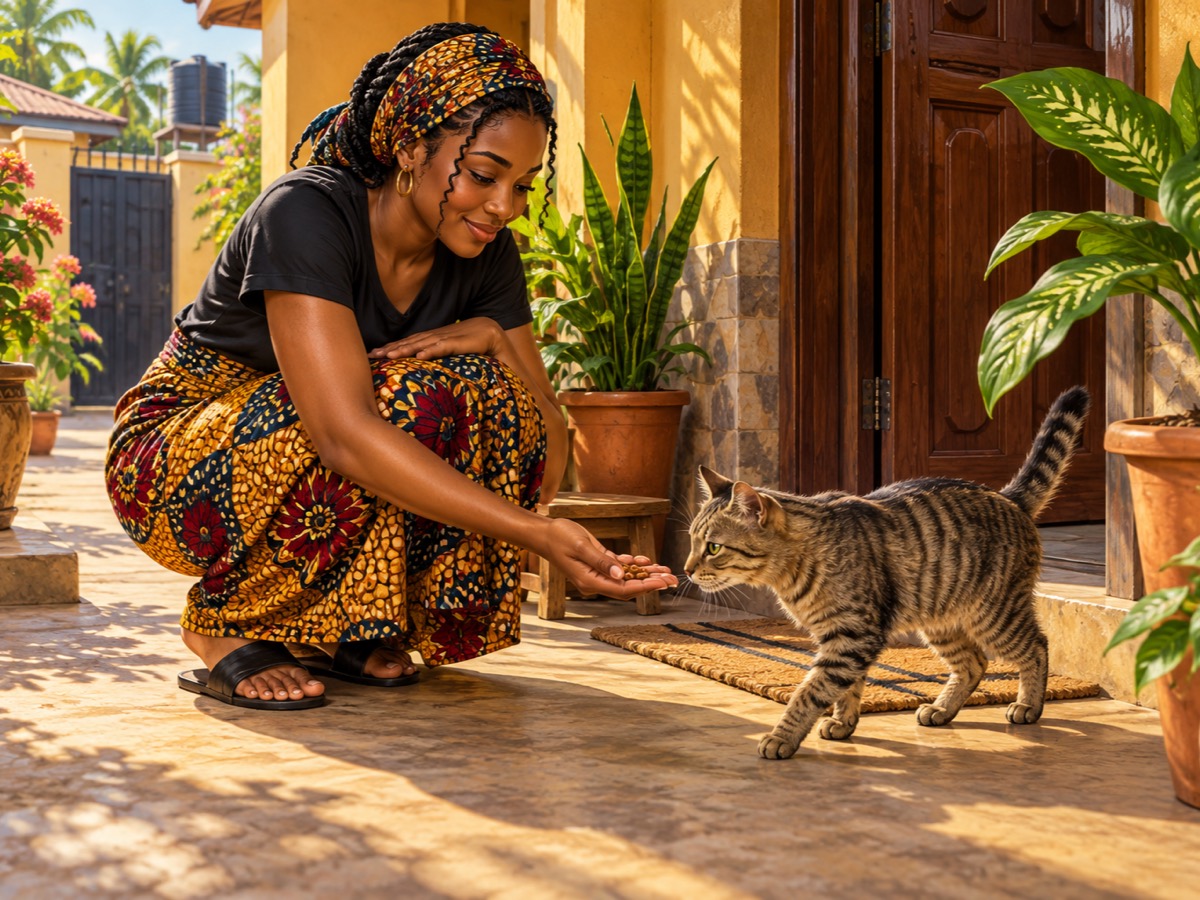
Socialization experts everywhere give the same advice: go slow, and let the cat set the pace. Feed at the same time and place every day, moving the bowl gradually closer to your door over days and weeks. Sit nearby while she eats, first far, then closer, doing something quiet and unthreatening. Talk softly. Do not stare, do not grab, do not chase. The day she eats while you sit an arm’s length away, you have done the hardest part.
Touch comes last, not first. Offer a knuckle to sniff. Let her initiate rubbing. A street cat that has decided you are safe will often become intensely affectionate, but a grab before she is ready can undo weeks of work and teach her that your hands are traps.
The vet visit is not optional
Before a street cat crosses your threshold and joins your household, she needs to see a registered veterinarian. This is the step Nigerian adopters most often skip, and it is the one that protects your family, your other pets, and the cat herself.
- Rabies vaccination first. Rabies is endemic in Nigeria and it kills people. Any animal of unknown history must be vaccinated, and you should avoid handling in ways that risk bites or scratches until that is done.
- Core vaccines and deworming. Street cats almost always carry intestinal worms, and often fleas, ticks, or ear mites. A vet will treat all of these cheaply and set up a vaccination schedule.
- A general health check for wounds, skin disease, and infections common in outdoor cats.
- Spaying or neutering. This is the kindest single thing you can do. It stops the endless kitten cycles that exhaust female cats, reduces roaming and fighting in males, and means you are not multiplying the same street-cat population you just rescued one member of.
Getting her there is its own small project. A borrowed carrier or a sturdy basket with a secure cover works; feeding her inside the open carrier for a few days beforehand makes the capture calm instead of traumatic. Never carry a semi-tame cat loose in a car.
From compound to parlor: the settling-in period
Once she is health-checked, start her in one quiet room rather than giving her the whole house. A spare room or bathroom with food, water, a litter box, and a hiding place, such as a carton on its side with a cloth inside, lets her map a small territory and feel in control. Expect her to hide for the first days. Visit calmly, talk, sit, leave. Most street cats take days to weeks to relax, and the transformation, when it comes, is astonishing: the wary shadow from behind the water tank becomes a cat asleep on your chair as if she signed the lease herself.
Litter training is rarely a battle. Cats instinctively dig; fill a basin with sand or commercial litter and show her where it is. Keep it far from her food and clean it daily. If you already have cats or a dog at home, introductions need their own careful staging through a closed door first, and our guide to introducing a new cat to resident pets walks through it step by step.
Decide early whether she will be indoor-only or indoor-outdoor. In a walled compound, many Nigerian cats live happily with supervised outdoor time. What changes after adoption is that she now goes out fed, vaccinated, neutered, and with somewhere safe to sleep, which removes most of the dangers of street life.
Why this is worth doing
Adopting a street cat costs a fraction of buying a pedigree kitten, and you get an animal already proven against the Nigerian climate, with the survival intelligence that makes local cats such engaging companions. You also become part of the solution to a real problem: unmanaged cat populations breed hard lives and short ones. One neutered, vaccinated, loved cat is a small victory that you get to live with, purring, for the next fifteen years.