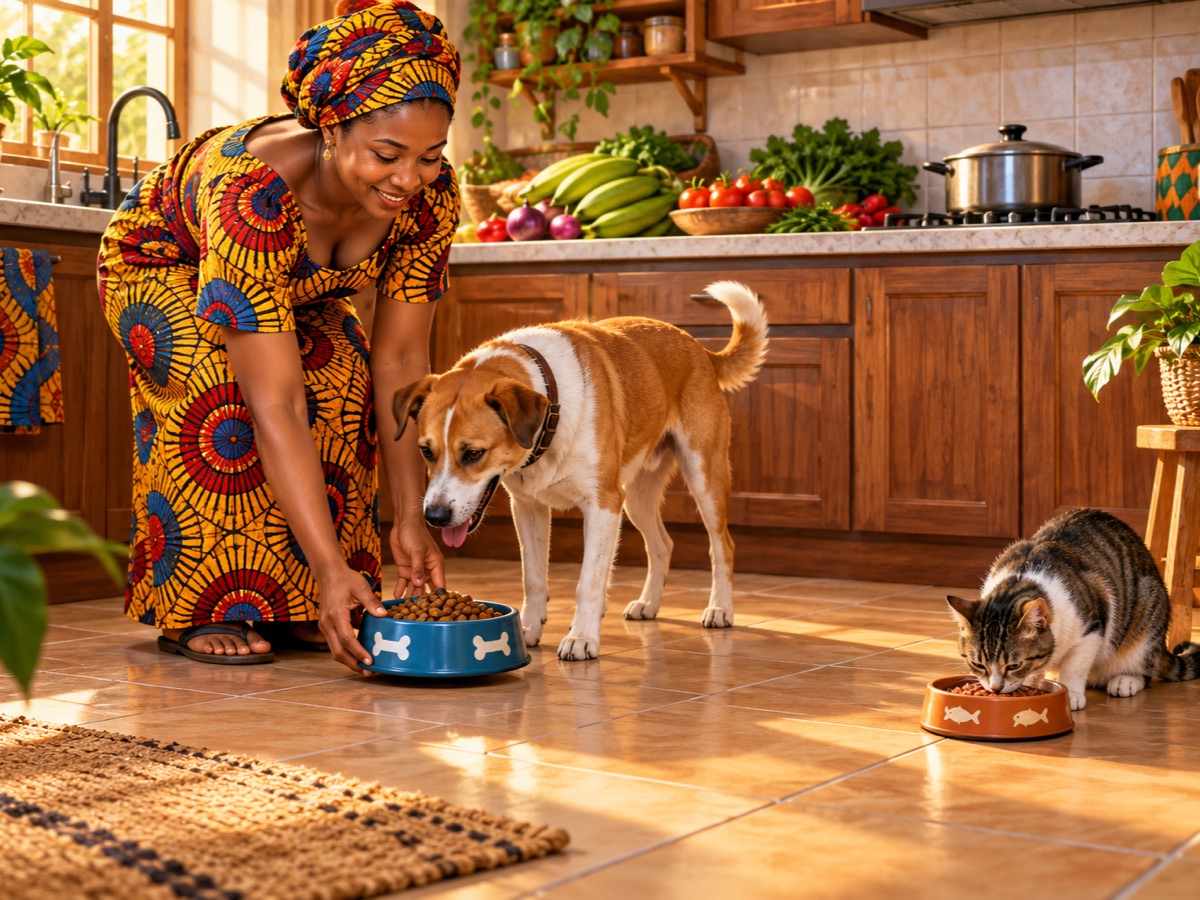
Imported pet food is expensive here, and the price moves. So most Nigerian households feed some mixture of whatever is affordable: leftover rice, bones from the pot, local dog meal from the market, kibble when things are good. The animals survive this. Some do badly on it in ways that only show up years later, in a vet bill much larger than the food ever was.
This is not about what to spend, because prices move and your situation is yours. It is about strategy: which decisions actually affect your animal’s health, and where you can economize without doing damage.
Start with what "complete and balanced" means
A dog or cat does not need expensive food. It needs food containing everything it requires, in roughly the right proportions, every day for years. WSAVA nutrition guidance puts it plainly: whatever you feed, commercial or home-prepared, the question is whether it is safe and nutritionally complete and balanced. Price is not the test. Completeness is.
What goes wrong when a diet is incomplete is rarely dramatic. It is slow. Analyses of home-prepared pet diets have repeatedly found them short on specific nutrients, and the same shortfalls recur: calcium, phosphorus, zinc, magnesium and iron. The classic consequence in a meat-and-rice-fed dog is nutritional secondary hyperparathyroidism, a calcium deficiency disease that weakens growing bones. It is entirely preventable.
So cooking for your pet is not automatically cheaper or kinder. Veterinary sources are direct that a home-cooked diet cannot be assumed adequate, and that recipes copied from books and websites frequently are not. Done properly it uses a recipe formulated by someone qualified plus the specific supplement that recipe calls for. Done casually, it is a slow deficiency.
The realistic options, and the trade in each one
Nobody has unlimited choice here, so weigh what is available to you.
- A complete commercial food, imported or locally produced, is the lowest-effort way to get completeness. Read the label and look for a statement that the food is complete and balanced for your animal’s life stage, rather than buying on brand reputation or packaging.
- A commercial base stretched with home-cooked food is what most households do. It works best when the commercial food is the clear majority of the diet and the additions are small and sensible, not the reverse.
- Fully home-prepared feeding is viable but only with a properly formulated recipe and supplementation. Treat it as a project you set up once with professional input, not something you improvise weekly.
- Local market feeds vary enormously. Some are reasonable, some are mostly cheap starch. Ask what is in it, look at the animals of customers who have used it for a year, and be skeptical of anything sold purely on price.
Whatever route you take, change it slowly. Switching abruptly tends to produce diarrhea, and diarrhea in a hot climate is a dehydration risk, not just a mess. Mix the new food in over a week or more. Our guide to portions and feeding schedules covers the mechanics of that transition.
Cats are not small dogs, and this one is not negotiable
If you have a cat, this is the most important section here. Feeding a cat dog food, or the rice-and-fish-bone arrangement many compound cats get, carries a specific and serious risk.
Cats cannot make enough of an amino acid called taurine for themselves, and they cannot store it. Dogs can produce their own. That means taurine has to arrive preformed in a cat’s food, from animal tissue, every day. Veterinary sources state plainly that cats fed food made for another species, dog food included, are likely to become taurine deficient.
Deficiency causes dilated cardiomyopathy, in which the heart muscle stretches and fails. It is now rare where cats eat supplemented commercial cat food, which tells you how preventable it is. Merck’s veterinary reference notes the remaining cases turn up in cats fed noncommercial diets or dog food, and untreated the prognosis is grave. Deficiency also damages the retina and can cause blindness.
So if your budget forces one compromise, do not let it be this one. A cat needs cat food. If commercial cat food is genuinely out of reach, talk to a vet about a formulated home diet with taurine supplementation rather than guessing. Do not assume fish scraps cover it.
What Nigerian kitchen food does to animals
The problem with feeding pets from the pot is not the leftovers themselves. It is that our cooking is built on things that harm them.
- Onion and garlic. These cause a destructive anemia in dogs and cats, and toxicology references are clear that raw, cooked, dried and powdered forms all do it. Cats are the most sensitive species, and garlic is several times more toxic than onion. Signs can take days to appear, so nobody connects the stew to the sick animal. Almost every Nigerian stew base is built on both.
- Cooked bones. They splinter, and the fragments can lodge in or puncture the digestive tract. Chicken and fish bones from the pot are a surgical risk, not a treat.
- Heavy fat. Oily food can trigger pancreatitis, which is painful, expensive and sometimes fatal.
- Salt and pepper. Food seasoned for people is seasoned far beyond what a small animal should take.
Plain additions are different. Unseasoned rice, plain boiled meat or liver, plain egg and some plain vegetables can genuinely stretch a food budget. Cook it separately before the stew base goes in, or do not give it, and keep it a portion of the diet rather than the whole thing.
Where to economize, and where not to
Budget feeding is mostly about putting your money in the right place rather than spending less of it.
- Worth paying for: completeness, species-appropriate food for cats, and a diet suited to the life stage. Puppies, kittens, pregnant animals and seniors have real differences in requirement.
- Worth paying for: parasite control and vaccination. A dog riddled with worms is being fed and gaining nothing from it, so deworming is a feeding intervention as much as a medical one. The parasite picture in our region is covered in common pet health risks in West Africa.
- Safe to skip: grain-free and boutique formulations, exotic protein sources, and premium pricing for a label claim you cannot verify. None of that beats a basic complete food.
- Safe to skip: most supplements, unless a vet has recommended one for a specific reason. Random supplementation of a complete food can actively unbalance it.
- Real savings: the largest bag you can store properly, kept sealed and dry so it does not spoil in the humidity, and not overfeeding.
That last point is the one people miss. Overfeeding is money spent on a problem. An overweight dog in Nigerian heat struggles to cool itself and strains its joints, and will cost more at the clinic than the extra food cost at the shop.
Judge the animal, not the bag
Feeding guides on packaging are averages, and your animal is not an average. Learn to read your own pet: you should feel the ribs easily under a thin covering without seeing them stand out, with a visible waist from above and a tuck-up from the side.
Check that monthly with your hands and adjust the amount up or down. A dull coat or persistent lethargy on an adequate amount of food is a reason to see a vet, not to buy a supplement.
Feeding well on a constrained budget is completely achievable. It takes attention rather than money: one complete food as the foundation, cat food for cats, nothing from the stew pot, clean water always available, and a hand on the ribs once a month. If you are working out what the whole animal will cost you, our guide to budgeting for a pet in Nigeria puts food in context with everything else.