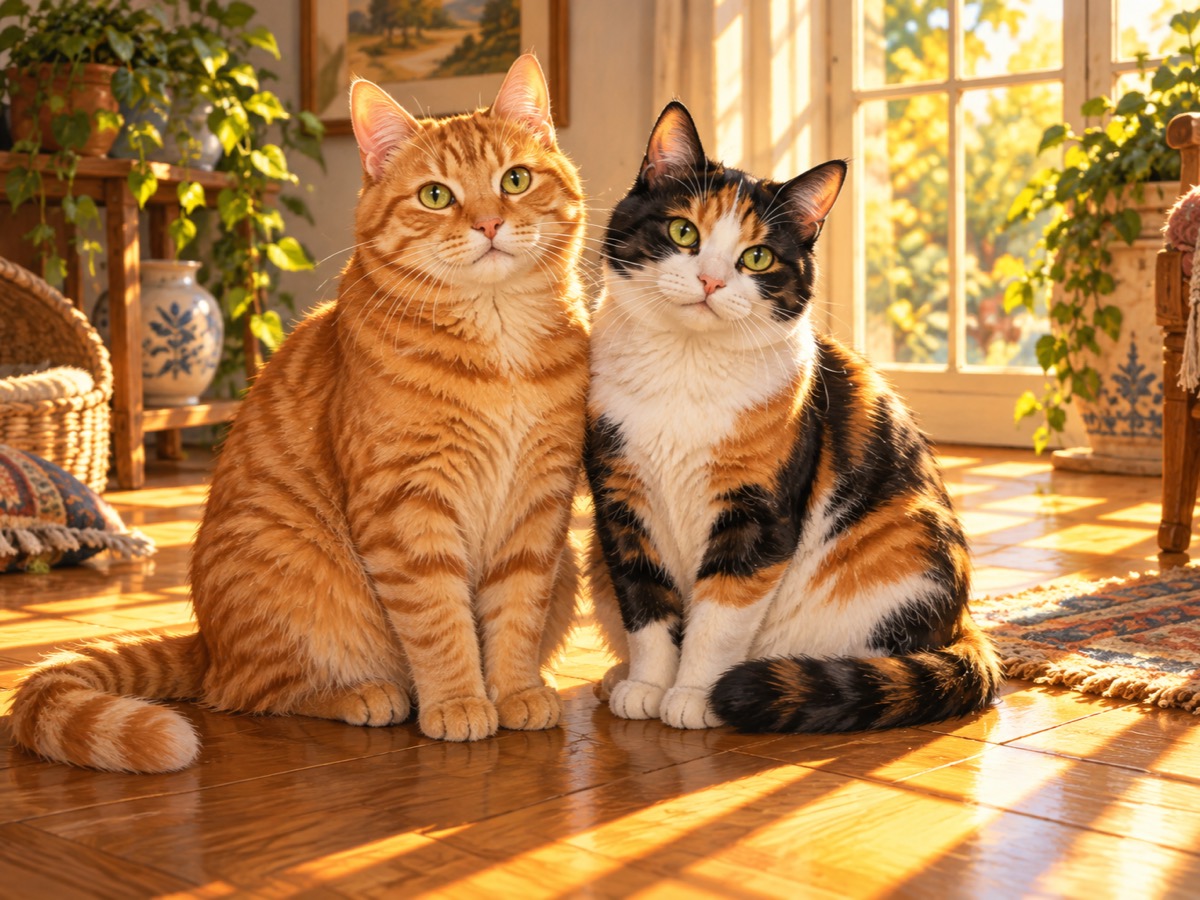
Roughly four out of five orange cats are male. Calicos and tortoiseshells are almost always female. Cat people have known this for generations, and geneticists have understood the reason in outline for over a century. What nobody could tell you until 2025 was which gene was actually doing it.
That gap finally closed in May 2025, when two independent research groups published the answer in the same issue of the same journal. The result is one of those rare cases where a piece of folk knowledge, a textbook diagram, and a molecular mechanism all snap into alignment.
The part that was already settled: X-linkage
Cats produce two pigments. Eumelanin is the dark one, giving black and brown. Pheomelanin is the light one, giving red, orange, and cream. The gene that flips a cat’s coat from making eumelanin to making pheomelanin has long been called sex-linked orange, and it was known to sit on the X chromosome.
From there the arithmetic is straightforward. A male cat is XY, with a single X. He inherits one copy of the orange locus, from his mother, and whatever it says goes. One orange variant makes an orange cat. A female cat is XX, carrying two copies, and needs the orange variant on both to be fully orange. That is simply less likely to happen, which is why solid orange cats skew heavily male.
Why calicos and torties are female
The patchwork coats follow from a second phenomenon: X-chromosome inactivation. Early in the development of a female mammal, each cell randomly switches off one of its two X chromosomes and keeps it switched off, and every daughter cell inherits that same choice.
Now picture a female cat carrying orange on one X and non-orange on the other. Some cells silence the non-orange X and go on to produce orange fur. Others silence the orange X and produce black or brown. Because the choice is made early and then propagated through cell division, the result is patches rather than a blend. Tortoiseshell cats show mottled orange and dark; calicos add white from a separate gene that limits where pigment cells settle at all.
This is why a tortie or calico coat is, as the Kyushu University team put it, the textbook example of X-chromosome inactivation. You are literally looking at which X won in each region of the cat’s skin. A male, with only one X to work with, has no second chromosome to make a competing patch, which is why male calicos are so rare.
They do exist, though, and the exceptions are instructive:
- XXY males. A cat with an extra X chromosome can be phenotypically male and still carry two orange loci to shuffle. These cats are typically sterile.
- Chimeras. Two embryos fusing early in development produce one animal built from two cell lines, which can generate patchwork coloring by a completely different route. We cover this in unraveling the mystery of chimera cats.
- Somatic mutation. A mutation arising in a developing tissue can produce a patch of unexpected color without any of the above.
Worth stressing: most calicos and torties are ordinary X-inactivation, not chimeras. The chimera explanation gets applied far too freely online, and our guide to telling chimeras from calicos and torties walks through the difference.
The 2025 discovery: ARHGAP36
What none of the above explained was which gene sex-linked orange actually is. Coat color genes in other mammals are well characterized, and the obvious candidates on the cat X chromosome kept failing to match.
In May 2025, two teams published the answer simultaneously in Current Biology. One was led by Distinguished Professor Hiroyuki Sasaki at Kyushu University’s Medical Institute of Bioregulation, funded in part by cat lovers through crowdfunding. The other came from a group at Stanford. Both landed on the same gene: ARHGAP36, on the X chromosome.
The mutation is not what you might expect. Every orange cat examined carried a deletion, and the non-orange cats did not, but the deletion sits in a non-coding region of the gene rather than in the protein-coding sequence. The ARHGAP36 protein itself is unchanged. What the deletion removes is a stretch of regulatory DNA that normally keeps the gene switched off in pigment cells. Take that brake away and ARHGAP36 stays active where it should be silent.
The downstream effect is a shift in the pigment factory. Elevated ARHGAP36 in melanocytes suppresses the machinery of eumelanin synthesis, including genes such as TYRP1 and DCT. With eumelanin production dampened, the cell defaults toward pheomelanin, and the fur comes out orange.
It is a mechanism worth appreciating. Orange is not a gene for making orange pigment. It is a gene that gets switched on in the wrong place and interferes with making the dark pigment, and orange is what remains.
What this does and does not tell you about orange cat personalities
You have heard the stereotype. Orange cats are supposedly bold, friendly, food-obsessed, and short on caution.
The discovery does hand that folklore an interesting hook, because ARHGAP36 is not only a pigment gene. It is important in development and is active in other tissues, including brain and hormonal gland tissue. That makes a behavioral link at least conceivable rather than absurd.
But conceivable is not demonstrated. The 2025 papers identified a deletion that causes orange coloration through melanocyte-specific expression. They did not show that this deletion alters behavior, and no study has established a causal link between coat color and temperament in cats. There are also large confounders sitting right in the middle of the question: most orange cats are male, sex and neuter status genuinely do influence feline behavior, and human expectation shapes how we interpret the same behavior in a ginger cat versus a black one.
The accurate position today is that the ginger cat personality remains folklore with a newly plausible avenue for future research, and nothing more. Behavior in cats is far better predicted by socialization, environment, and health than by color, as we discuss in our look at chimera cats and elsewhere on the site.
Why any of this matters
Beyond satisfying curiosity, the finding is a clean demonstration of something biology keeps proving: a lot of visible variation comes from changes to when and where a gene is expressed, not from changes to the protein it encodes. The regulatory DNA between genes turns out to be doing an enormous amount of work.
It also means the next time you see a calico asleep in a patch of sun, you can read her coat as a record of a decision each of her cells made before she was born, and now name the exact gene the decision was about.