When the weather closes in, the walk gets shorter. Not by a decision — by five minutes here, a skipped evening there, until a dog who was getting ninety minutes a day is getting twenty-five and nobody noticed the change happen. Cats feel it too, in a quieter way: the window ledges go cold, the household moves less, and a cat who used to patrol starts sleeping nineteen hours instead of sixteen.
The problem is not the lost calories. It is the lost stimulation. A dog who has nothing to do turns that energy on your furniture, your shoes, or themselves, and a bored cat starts overgrooming or picking fights with the other cat. The good news is that indoor work is unusually efficient — mental effort tires an animal far faster than distance does, and you can deliver a lot of it in a small flat.
Put the nose to work first
If you only change one thing, change this. Scent work is the highest-value indoor activity available to dog owners, it needs no equipment, and it works in a hallway.
Start with the simplest version. Take a handful of your dog’s kibble and scatter it across a rug or a towel, and let them hunt it out. That is a snuffle mat without buying a snuffle mat. Once they understand the game, make it harder:
- Hide small portions of food in five or six places around one room while your dog waits in another, then release them with a cue word and let them search.
- Put treats inside a cardboard box stuffed with crumpled paper, and let them dig. Supervise so nothing gets eaten that should not be.
- Line up three cups or boxes, let your dog watch you hide food under one, then shuffle them. Most dogs solve this by smell within a few rounds.
- Hide yourself. Have someone hold your dog, tuck yourself behind a door, and call once. Then reward enthusiastically when they find you.
Ten minutes of searching visibly settles most dogs in a way that ten minutes of ball-throwing does not. If you are working out whether your dog is actually getting enough overall, our guide to how much exercise your dog really needs is the place to calibrate.
Train in five-minute blocks
Training is exercise. A dog learning something new is concentrating hard, and concentration costs energy. Trainers and shelter behavior teams converge on the same prescription for indoor months: short sessions, five to ten minutes, ended while the animal is still keen.
Keep it entirely reward-based. You are marking the behavior you want with a treat, a word, or a game, and simply not rewarding the rest. There is no place for leash corrections, scolding, or startling your pet in any of this — punishment-based methods damage the trust you need for the dog to keep offering new behaviors, which is the whole engine of indoor training.
Good cold-season projects include teaching a chin rest, a hand touch, sending to a mat and settling there, walking backward, learning the names of two or three toys, or weaving between your legs. None of it needs space. All of it gives your dog something to think about and gives you a calmer animal at the end.
Stop using the bowl
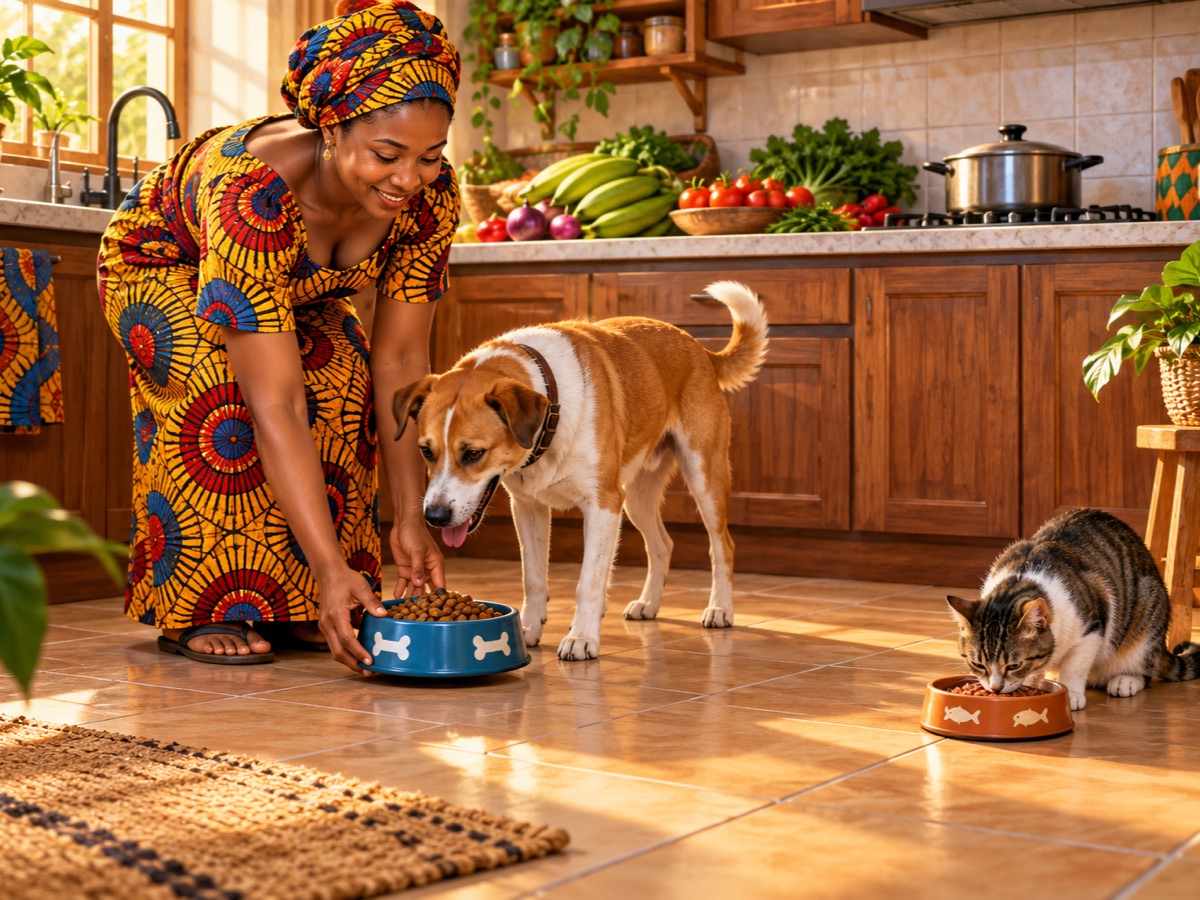
A bowl turns a meal into a thirty-second event. A food puzzle turns the same meal into fifteen or twenty minutes of problem-solving, twice a day, with no effort from you once it is set up.
For cats, this is the single best-supported indoor intervention there is. A review in the Journal of Feline Medicine and Surgery written to help vets advise clients lays out food puzzles as a tool for both physical and emotional wellbeing — while being honest that the published evidence base is still thin and much of the support is case-based. Behavior specialists at UC Davis make the related point that feeding methods which mimic hunting, such as a food tower or an interactive puzzle board, line up with what cats are built to do.
Introduce them gently or they get abandoned in a cupboard:
- Start on the easiest setting. A clear puzzle with several large openings lets your pet see and smell the food inside, which is what gets them to engage at all.
- Feed the normal daily ration from the puzzle rather than adding it on top. This is a delivery method, not extra food.
- Have more than one puzzle so you can rotate, and put them in different places.
- Homemade works. A muffin tin with kibble in the cups and tennis balls on top, or a plastic bottle with holes punched in it, does the same job for free.
- In a multi-cat house, give each cat a puzzle in a separate spot. Guarding ruins the whole exercise.
For cats, think vertical and think sequence
The AAFP and ISFM feline environmental needs guidelines, which AAHA has endorsed, are built on five pillars — a safe retreat space, separated key resources, opportunity for play and predatory behavior, positive and predictable human interaction, and respect for the cat’s sense of smell. They apply to every pet cat regardless of lifestyle, and they are worth reading as needs rather than extras.
Two of those pillars do the most work when everyone is stuck indoors. The first is resources: food, water, litter, scratching, resting, and play areas should be spread apart rather than clustered, with at least two options for each, and at least as many safe retreat spaces as you have cats. In a cold house this often means nothing more than adding a second warm resting spot away from the first, so one cat cannot monopolize the good one.
The second is predatory play, and the trick is to respect the whole sequence rather than just the chase. A hunt is stare, stalk, chase, pounce, bite, then eat. So run a wand toy until your cat catches the lure, let them actually win it, and then feed a few pieces of food. Ending on a catch and a meal is what leaves a cat satisfied instead of wound up. Two or three short sessions a day beat one long one, and the dusk slot usually gets the biggest response. Our guides to indoor cat enrichment and interactive games for cats have more ideas than will fit here.
Watch for the signs you are falling short
Animals tell you before you work it out for yourself. Pay attention if you start seeing new destructiveness, pacing or restlessness in the evening, barking at nothing, demand behavior that was not there in autumn, waking you at night, overgrooming, litter box problems appearing out of nowhere, or new friction between pets who normally tolerate each other.
Those are usually an unmet-needs signal rather than a training problem, and adding structured activity fixes a surprising number of them. But do not assume. A sudden behavior change can equally be pain, and a cat straining in the litter box or a dog who has stopped wanting to move needs a vet rather than a puzzle feeder. Weigh your pet too — reduced activity plus unchanged portions is how the cold months quietly add weight.
Build it into the day and it stops being a project. Scatter breakfast instead of pouring it, five minutes of training while the kettle boils, a wand toy before dinner, a puzzle at night. That is maybe twenty minutes of your time and it carries most pets comfortably through to the first warm week.